2. What Didn’t Sprout, and What Does It Still Need? 🌱
Every year has seeds that never broke ground. The career change still sitting in a drawer, the relationship that didn’t mend, the novel you started three times. Under a full moon, the temptation is to file them under “failures.” I’d like to offer you a different column: “dormant.”
Nature makes the very same distinction. Winter wheat, the kind farmers sow in the fall, can’t head out unless it has lived through the cold: agronomists call this vernalization. Planted in spring, it stays grassy and yields nothing. Planted in October, it spends the winter underground, and that cold is exactly what signals it to flower. Some of your seeds didn’t miss their season: they’re waiting for theirs. They may need a winter, some time to mature, a meeting, a budget, a courage that hasn’t arrived yet.
What this question rekindles is patience with yourself, and it keeps you out of two traps: giving up on what only needed time, and clinging to what was never meant for you. Because there are also seeds that will never sprout, and that’s perfectly fine. The review is how you recognize them.
How to answer it: on the next page, write down no more than three projects that didn’t come through. For each one, finish the sentence “It still needs…”. If the answer comes easily (“it still needs time,” “it still needs a class”), the seed is alive. If nothing comes, or if the only honest answer is “it needs me to be someone else,” you may have your answer: this is a seed you can return to the earth, with gratitude.
3. Who Fed My Year, and Did I Tell Them? 🤲
No harvest happens alone. Behind every line on your first list, there’s someone: the coworker who covered for you, the friend who called at the right moment, the neighbor who fed the cat, the doctor who actually listened, the stranger who smiled at you on a rainy day. This question moves the review from “me” to “us,” which fits perfectly: that’s exactly the axis of this full moon, between Aries and Libra.
It isn’t just a lovely idea. In 2003, psychologists Robert Emmons and Michael McCullough published a now-famous study, Counting Blessings Versus Burdens. For ten weeks, one group wrote down five things they were grateful for each week, another five hassles, and a third five neutral events. The people counting their blessings felt more optimistic about the coming week and about their lives as a whole, exercised more and reported fewer physical complaints. Five things, once a week: that’s roughly what I’m inviting you to do tonight, with faces instead of things.
What this question rekindles is connection. We often believe we carried our year alone, and a list of names disproves that in thirty seconds. If this gesture speaks to you, these everyday gratitude practices carry it beautifully through the whole fall.
How to answer it: write down five names, no more. Next to each, one line: what this person brought you this year. Then circle one. That’s the person you’ll message within three days. No long speech, one sentence is enough: “I was thinking back on this year, and I wanted to thank you for…”. Trust me, it’s often the most powerful moment of the ritual, and it happens afterward.
4. What Am I Still Carrying That Isn’t Mine Anymore? 🎒
This is the question of the overstuffed attic. Every year leaves behind things we keep carrying without quite knowing why: a promise made to someone who no longer remembers it, an “I really should…” that has followed you since January, a grudge, a role someone handed you that you never chose, a goal that was really your parents’. What you haven’t finished takes up space, even when you’re not thinking about it.
Psychology has a name for that hunch. In 1927, a young researcher named Bluma Zeigarnik, a student of Kurt Lewin in Berlin, published an experiment that started with an observation in a café: waiters remembered unpaid orders perfectly, then forgot them the moment the check was settled. In her experiment, participants remembered the tasks that had been interrupted better than the ones they’d been allowed to finish. The effect has been widely debated since, and it varies with people and situations; but the image speaks to everyone. An open task is a little light left on in a back room.
What this question rekindles is your energy. It doesn’t ask you to finish everything before December 31. It asks you to close the door on some rooms, deliberately. And the simplest way I know comes from a very down-to-earth tool. Ryder Carroll, the New York designer who created the Bullet Journal, calls it “migration”: at the end of each month, you rewrite by hand every unfinished task onto the new page. That little chore is the whole point: if a task isn’t worth the effort of being copied out again, it isn’t worth keeping, and you cross it out.
How to answer it: list everything that still weighs on you, in no particular order, for two minutes. Then go back through it line by line. For each line, only two choices: strike it through with one firm stroke, or rewrite it by hand on a fresh page. No third “we’ll see” column. What you cross out, you lay down under the Moon. What you rewrite, you choose all over again, and this time for real.
5. What Will I Do With the 96 Days That Are Left? 🗓️
Do the math with me. Saturday, September 26, is day 269 of 2026. That leaves 96 days until December 31. Ninety-six days is a little over thirteen weeks, three more full moons, and plenty of time for an intention to take root. It’s also short enough that it won’t fizzle out.
That’s the whole point of doing your year-end review now and not in December. In December, we review the year to judge ourselves and make resolutions to catch up. At the end of September, we review it to act, because a whole season still lies ahead. Farmers knew it: Michaelmas wasn’t only the end of a farming year, it was when the fall sowing began. And the sky is nudging you the same way: on Sunday, September 27, at 10:48 p.m. ET, Mars enters Leo, and drive comes back.
What this question rekindles is your power to choose. Not a list of ten goals, one direction. When you set too many courses, you keep none of them; when you keep one, the others often follow.
How to answer it: reread your first four pages. Then, on a blank page, write a single sentence in the present tense, starting with “Between now and December 31, I…”. “Between now and December 31, I give myself one screen-free evening a week.”
“Between now and December 31, I finish that project and I book that appointment.” If two sentences come to you, keep the one that scares you a little. It’s usually the right one.
The Harvest Moon Ritual of the Five Questions: 25 Minutes 🕯️
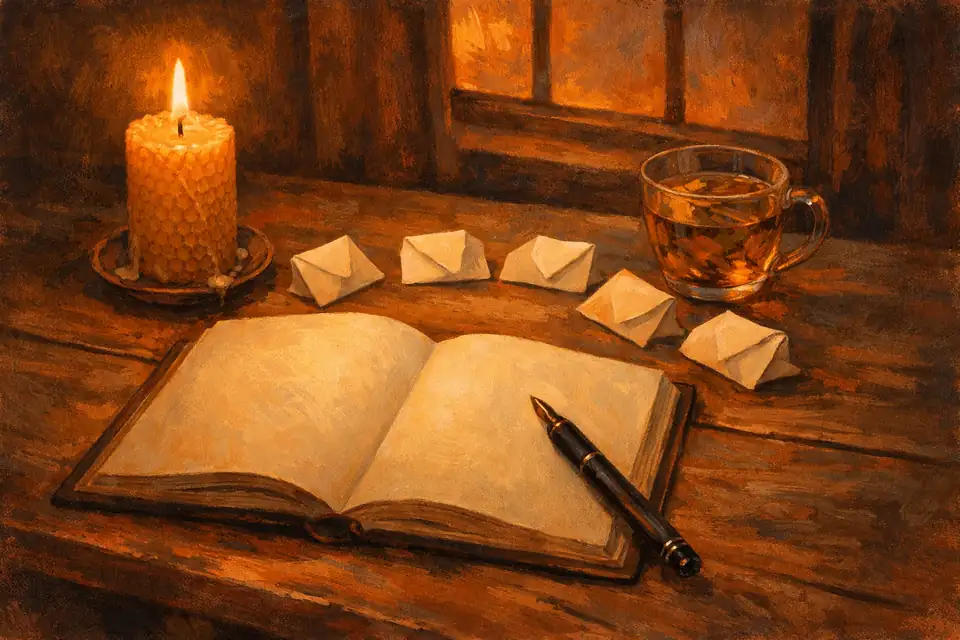
This reflective ritual is done alone, at home, in under half an hour. Gather: a notebook you like (or a few stapled sheets), a pen that writes well, a candle, a cup of herbal tea or a glass of water, and a timer; the one in your kitchen will do. If you have one, a stone you like to hold.
⭐ The ideal time: Saturday, September 26, 2026, in the evening, after 6:34 p.m. The Moon is exact at 12:49 p.m. ET and rises in New York just before sunset. If the sky is cloudy or the evening gets away from you, Friday or Sunday night work beautifully: the Moon still looks full, and it rises less than half an hour earlier or later. What matters is the appointment you make with yourself, not the exact minute.
1. Set up your space. A table near a window, ideally facing east, where the Moon rises. Lay out the open notebook, the pen, the unlit candle, your cup. Put your phone in another room, on silent: yes, really, this part isn’t optional. Twenty-five minutes without a notification is already a gift.
2. Arrive. Sit down, both feet on the floor. Take three slow breaths, counting to four as you breathe in and to six as you breathe out. If the Moon is visible, look at it for one minute without doing anything else. It has lit the fields for as long as humans have harvested; it can light your table.
3. Light the candle and set your intention. On a stable holder, away from the papers. As you light it, say softly: “Tonight, I look at my year as it was, without dressing it up and without tearing it down.” That sentence is the contract of the ritual. Reread it whenever you feel judgment creeping in.
4. Harvest (question 1, 4 minutes). Set the timer. Write the list of your harvests, one word per line, without stopping. When the timer goes off, put the pen down, even mid-line. Read it out loud. You may be surprised at how long it is.
5. Look at the sleeping seeds (question 2, 3 minutes). Three projects at most, and for each the sentence “It still needs…”. If one of them no longer deserves to wait, write next to it: “I’m returning you to the earth.”
6. Give thanks (question 3, 4 minutes). Five names, five lines. Circle the one you’ll write to. Take a sip from your cup as you think of those five people, one after the other.
7. Clear out the attic (question 4, 4 minutes). Two minutes to list everything, two minutes to sort: cross it out or rewrite it by hand. What you cross out, say it once out loud, then don’t go back to it tonight.
8. Choose your direction, then close (question 5, 3 minutes). One sentence: “Between now and December 31, I…”. Copy it onto a small slip of paper to tuck into your wallet or stick on your mirror. Give thanks to whoever you like: the Moon, the Universe, your spirit guides, yourself. Then put out the candle with a snuffer or by pinching the wick, without blowing. Close the notebook. The ritual is over; the work starts tomorrow.
After the Ritual: The Three Days That Matter 🌙
A ritual opens a door; the next three days decide whether you walk through it. And this year, the Moon keeps you company for those three days, since it still rises at nearly the same time.
The next day, Sunday the 27th, is the day the Moon meets Saturn. Reread your notebook with fresh eyes, in daylight. Don’t correct anything; just underline one sentence per question, the one that strikes you most. On the second day, send the thank-you message to the person you circled. On the third day, Tuesday the 29th, Michaelmas, take a first concrete step toward your December 31 sentence, however tiny: block out a slot in your calendar, buy the book, make the appointment. The old farmers’ quarter day is a lovely day to start your own new season.
What you don’t need to do: wait for a spectacular sign, or feel transformed overnight. The Universe’s little signs are subtle, and a review works like a seed, slowly. If you’d like more concrete support for those days, it’s also a perfect night for charging crystals under the full moon, and the stones that keep you moving as the days get darker are made for the weeks ahead.
Keeping Your Answers From One Moon to the Next
Don’t throw that notebook away. Put today’s date on the cover, store it, and pick it up again at the next full moon, on October 26, then right before Samhain, the festival that marks the passage into darkness, which closed the year for the ancient Celts. You’ll see what has shifted. And next year, under the 2027 Harvest Moon, reread it before you open a new one: nothing is more instructive than reading what you hoped for twelve months ago.
What This Ritual Doesn’t Replace 🫶
I’d rather say it plainly. This full moon ritual is a moment of review and clarity. It isn’t therapy, it isn’t treatment, and it isn’t a guarantee that the last three months of the year will be easy.
Sometimes questions like these stir up something heavier than you expected: grief, loneliness, a tiredness that has lasted for weeks. If, as you answer, you feel sadness taking over, or if the shorter days have long come with disrupted sleep and a deep loss of interest, it’s no longer a matter for a notebook. It’s time to talk to a doctor or a mental health professional, and there’s no shame at all in doing so. Seasonal lows are easier to get through when you don’t let them settle in.
And a review doesn’t replace life itself. There’s no point writing “I want to see my friends more” if the notebook stays the only place it happens. Answers are meant to be lived, not admired.
What About Your Sign? The Aries-Libra Axis ⚖️
This Harvest Moon is a full moon in Aries, facing the Sun in Libra. Every sign feels it, but two feel it up close. If you’re an Aries, get to know your Aries zodiac sign a little better tonight: this is your full moon. It lights up what you started this year, and maybe what you started too fast. With Saturn and Neptune also in Aries, question 2 will probably speak loudest to you. Your Aries yearly horoscope will help you place this review in the rest of the year.
If you’re a Libra, the sign of balance, the Sun has just moved into your sign: your new solar year begins, and question 3, the one about the people in your life, is made for you. Your Libra yearly horoscope will tell you what the end of 2026 has in store. Cancer and Capricorn, square to this axis, may have to choose between home and career when they get to question 5.
But whatever your sign, the Harvest Moon asks everyone the same thing: what did you really harvest, and what will you choose to do with it?
❓ Harvest Moon: Your Questions Answered
When Is the Harvest Moon in 2026?
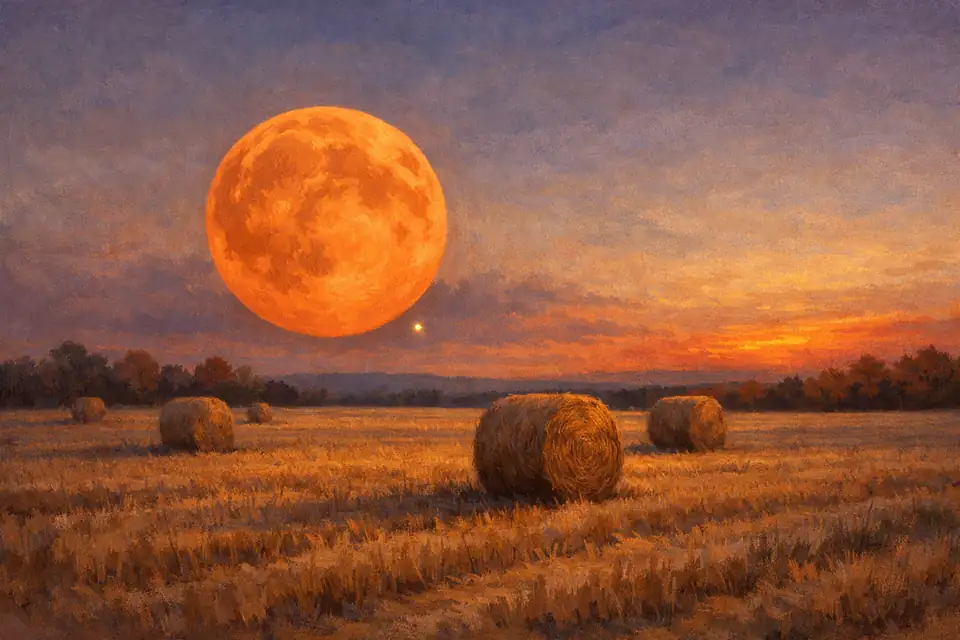
The 2026 Harvest Moon is full on Saturday, September 26, at 12:49 p.m. Eastern Time, in Aries. It’s the full moon closest to the fall equinox, which took place on September 22. In New York it rises at 6:34 p.m., then at 6:58 p.m. on Sunday and at 7:27 p.m. on Monday.
Why Is It Called the Harvest Moon?
Because around the equinox, it rises at almost the same time several evenings in a row, shortly after sunset. Its light once let farmers finish bringing in their crops after dark. This year in New York, it rises only 22 to 29 minutes later each night, compared with about fifty minutes on average.
What Questions Should I Ask Myself at the Full Moon?
The full moon is a time for taking stock rather than starting something new. Under the Harvest Moon, five questions are enough: what did I really harvest, what didn’t sprout, who fed my year, what am I carrying that isn’t mine anymore, and what will I do with the days that are left.
Should I Write My Answers Down or Just Think Them Through?
Write them down. Writing slows your thoughts and keeps you from going in circles; it also leaves a record you can reread at the next full moon or next year. A plain notebook is all you need, no special layout required.
Can I Do This Ritual if the Sky Is Cloudy?
Yes. The Moon works as an appointment, not a condition. If clouds hide it, the ritual keeps its full meaning: light the candle, ask the five questions, and look for the Moon another evening, Friday, Sunday or Monday, when it rises again at nearly the same time.
Why Do a Year-End Review in September Instead of December?
Because you still have 96 days to act. In the English countryside, Michaelmas, on September 29, was one of the quarter days when rents fell due and farm leases were renewed, and the U.S. fiscal year still ends on September 30. A late-September review helps you choose how to finish the year, not judge it once it’s over.
Can I Repeat This Ritual Every Full Moon?
Yes, and it’s an excellent habit. At each full moon, go back over the five questions for the month that just passed, five minutes each at most. The Harvest Moon remains the big review of the year; the other full moons become its milestones.
I ask myself these five questions every year under the Harvest Moon, and every year one of them pushes back. There have been autumns when I couldn’t write down three harvests, and others when the list of names had me crying with gratitude over my tea. What twelve years of practice have taught me is that the review is never the year’s verdict: it’s the first step of the season ahead. The Universe is a powerful ally, but it’s up to us to look at the field and do our part of the work.
The Harvest Moon decides nothing for you. It doesn’t tell you whether your year was good or bad, and it doesn’t promise you an easy last quarter. For a few evenings in a row, it lights up what you already hold in your hands. What you do with it over the 96 days that remain is your free will, and yours alone. The harvest is yours; so is the sowing.
Editor’s note: five questions, one notebook, one MoonYou don’t need an elaborate ritual to review your year. A notebook, a candle, twenty-five minutes and five honest questions: that’s all it takes to know what you’re bringing into the fall. The Harvest Moon rises Saturday evening, and it will be back at nearly the same time the next day. That’s its gift.
Is one question pushing back, or did an answer unsettle you more than you expected? A psychic reader knows how to walk you through this kind of review, and ask the question you don’t dare ask yourself alone on a full moon night. |
Do you know someone who always says the year “went by without them noticing”? Send them this article before Saturday night, and invite them to answer the five questions alongside you. 🌕
Read More 📚
Written by Madison Carter, spiritual guide, specializing in the Oracle of Light and seasonal rituals.













Did you like this article?
Want to know more 🤔 ?
Write directly to the authorMadisonCarter !
Ask Madison a question