2. The Grapes: What Ripens Slowly 🍇
Mabon falls right in the middle of the grape harvest, and that’s no small detail. The grape is the fruit of patience: it takes the whole summer to ripen, and what it becomes next, juice, wine, or vinegar, depends on time and on how it’s handled. In the vineyards of Europe, for centuries, people couldn’t pick whenever they liked: a proclamation fixed the day the harvest could begin, so that no one would cut grapes that weren’t ready. A good lesson for those of us who always want to harvest ahead of time.
In Greek myth, the grape belongs to Dionysus, the god who dies and is reborn, and the Mysteries of Eleusis I mentioned honored the same cycle of the seed that goes down into the earth and rises again in spring. So the Mabon grape speaks of transformation: what grew this year hasn’t finished becoming what it will be.
How to use it: a bunch of grapes in the middle of the table. During the review, pluck one grape each time you name something you’ve harvested this year, and drop it into a small bowl. At the end, you can literally see what your year has produced. You can also replace the bunch with a glass of grape juice, which you’ll sip at the moment of gratitude. Wine is traditional, but it isn’t required, and a ritual is best lived with a clear head.
What the grapes awaken: patience with yourself. Some of your harvests are still fermenting. They haven’t failed. They just aren’t ready yet.
3. The Wheat Sheaf: Keeping the Last Handful 🌾
Here’s the oldest of the four symbols, and the one that left the deepest mark on farm life. All across Europe, the last sheaf of the harvest wasn’t treated like the others. It was cut with ceremony, sometimes braided into a small doll, called the “Corn Mother,” the “Old Woman,” or the “harvest maiden,” and kept in the house until the next sowing. In Britain and Ireland, those woven figures are the ancestors of today’s corn dollies. The anthropologist James George Frazer devoted whole chapters of The Golden Bough to these customs at the end of the nineteenth century: the idea was to keep the spirit of the field alive through the winter so it would return in spring.
I find this gesture moving in its simplicity. You don’t keep everything: you keep one handful, the finest, and you put it somewhere safe. That’s exactly what Mabon asks you to do with your year: choose what deserves to spend the winter with you.
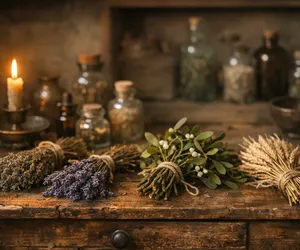
How to use it: a few dried wheat stalks, which florists and craft stores carry this time of year, or a small bundle of dried herbs, lavender, or rosemary. At the end of the ritual, tie one stalk with a bit of twine around the folded paper on which you’ve written your resolution for the season. This little sheaf stays on a shelf until Ostara in March. That evening, you’ll untie it and see what it has become.
What the sheaf awakens: your ability to set things aside. Not only money: energy, time, attention. Winter is prepared in September.
4. The Two Candles: Holding Balance as Night Wins 🕯️
Mabon is a festival of balance before it’s a festival of harvest. Day and night are even, and from the next day on, night wins, all the way to Yule and the winter solstice on December 21. That’s why I suggest not one candle but two, side by side.
The first is orange, gold, or red: the colors of the harvest and the sinking Sun. The second is white, or deep purple: the coming night, rest, the inner life. If you wonder why these shades, the guide to what each candle color means will shed some light, pun intended. What matters most is elsewhere: both candles are the same size, lit together, put out together. You’re not celebrating light against darkness; you’re welcoming both.
How to use them: set them on either side of the apple, on a heat-resistant plate or tray, away from curtains and dry stalks. Light the orange one first while thanking the summer, then the white one while welcoming the winter. Don’t blow them out at the end: use a snuffer, or pinch the wick with wet fingers. Never leave a flame unattended, and that goes double on full moon nights when you’re dying to get to bed.
What the candles awaken: your peace with the dark season. Autumn isn’t a punishment; it’s another way of living, slower and more inward. The people who dread it most are often the ones who need it most.
The Mabon Ritual: 25 Minutes to Review Your Harvest 🍂
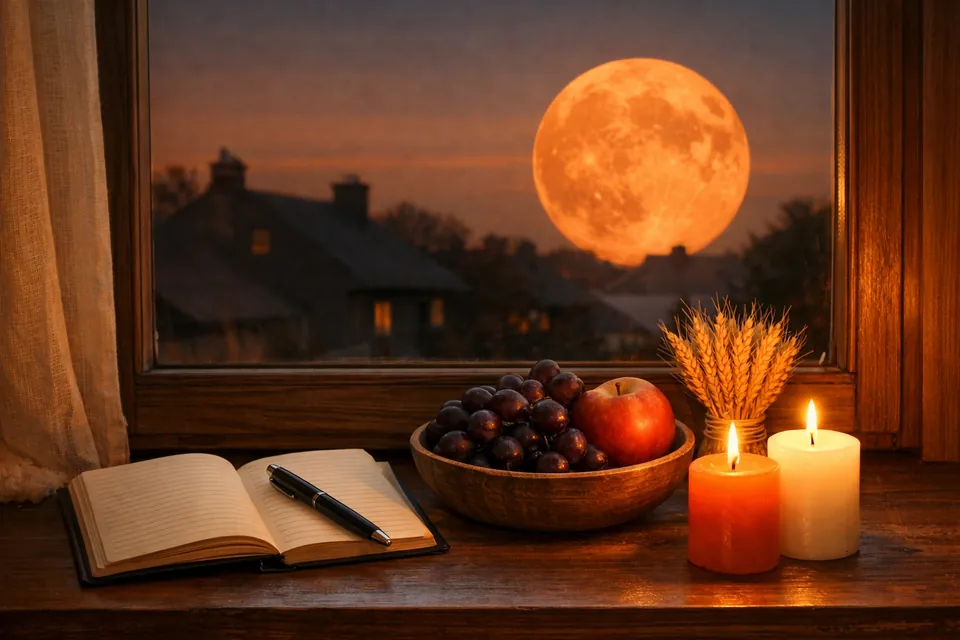
This ritual is done alone, at home, in under half an hour, with things you’ll find at the grocery store or in your cupboards. Gather: one apple, a small bunch of grapes (or a glass of juice), a few wheat stalks or dried herbs, two candles, a small bowl, a sheet of paper, a pen, a piece of twine. And, if you can, a handful of fallen leaves picked up outside.
⭐ The ideal moment: Saturday evening, September 26, 2026, under the Harvest Moon. It’s full at 12:49 p.m. ET, rises in New York at 6:34 p.m., and it’s the first evening of the year when the night lasts longer than the day. If Saturday doesn’t work, Sunday evening is just as good: the Moon still looks full. And if the week gets away from you, know that Mabon is traditionally celebrated throughout the equinox season: what counts is the gesture, not the clock.
1. Prepare the space. A table or a windowsill, ideally facing east where the Moon rises. Spread out the leaves, put the sheaf on the left, the grapes in the middle, the whole apple in front of you, and the two candles on either side. Turn off the screens. Put your phone in another room: yes, really.
2. Cleanse the space, simply. Open the window for two minutes to refresh the air, or pass a little smoke from burning sage or incense around the table. Meanwhile, breathe three times, slowly, counting to four as you inhale and to six as you exhale.
3. Light both flames. The orange one first: “Thank you, summer, for all you’ve given me.” Then the white one: “Welcome, coming night, I’m not afraid of you.” Let them burn for a minute in silence.
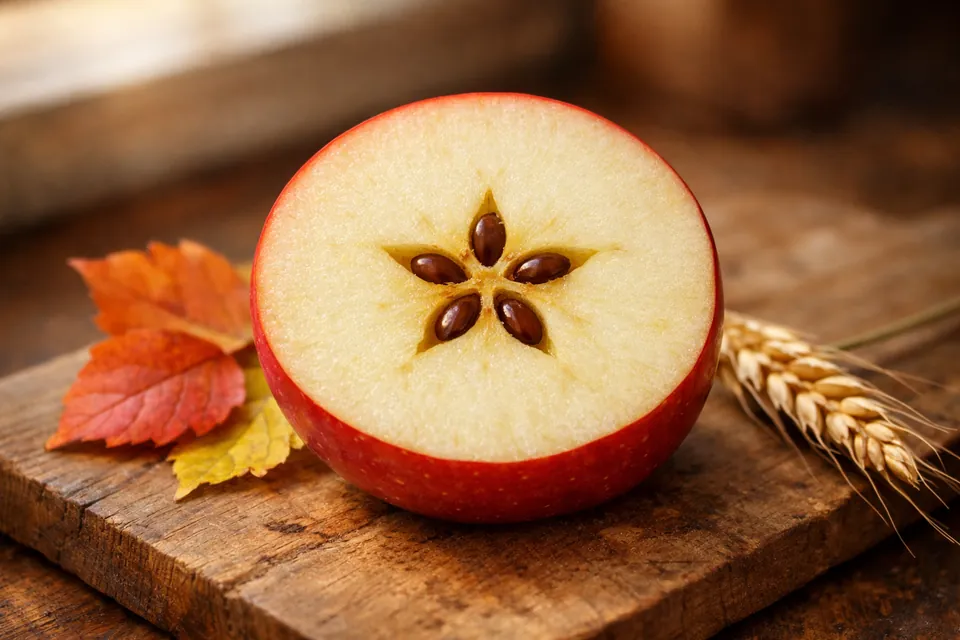
4. Cut the apple. Crosswise, in one motion. Look at the star. Take a first bite of the left half while thinking of one single thing: what this year has taught you. Not what it gave you. What it taught you.
5. Count your harvest. This is the heart of the ritual. For each thing you’ve harvested since spring, pluck a grape and drop it into the bowl, naming it out loud. A meeting. A courage you didn’t know you had. A project finished. A relationship repaired, or left behind. A hard diagnosis you got through. You’ll be surprised: after five or six grapes, the harvests start coming on their own. Count only what is real, not what you wish had happened.
6. Write down what you’re letting fall. At the top of the paper, one sentence: what you don’t want to carry into winter. A grudge, a habit, a “someday I should” that has been chasing you since January. Tear off that strip and slide it under the fallen leaves: it will leave with them tomorrow, to the compost or the recycling. No need to burn it, and it’s safer that way.
7. Tie up your reserve for winter. On the rest of the paper, write a single resolution for the season, in the present tense: “I keep time for myself every Sunday.” Fold it in four, wrap a stalk around it, tie it with the twine. This little sheaf is what you’re putting away until spring.
8. Give thanks, then close. Take a sip of juice or eat a grape from the bowl. Say thank you to whomever you like: the earth, the Universe, your spirit guides, yourself. Then put out both candles at the same time. If the Moon is visible, stay at the window a moment. It has lit the fields for as long as humans have been harvesting.
After the Ritual: the Three Days That Matter
The ritual opens a door; the three days that follow decide whether you walk through it. The next day, return the half apple and the leaves to the earth, along with the strip of paper. On the second day, take one concrete step, however tiny, toward your resolution: block out that Sunday slot in your calendar, for example. On the third day, reread the harvests you named; you can write them in a notebook, which will become your autumn gratitude journal. If that idea speaks to you, these everyday gratitude practices extend it beautifully. What you don’t have to do: wait for a spectacular sign. The little signs from the Universe are often quiet, and Mabon is a festival of endings, not beginnings.
Why Does the September 26 Harvest Moon Matter So Much? 🌕
Because it has a real astronomical quirk, and that’s what gave it its name. Around the fall equinox, the Moon’s path meets the eastern horizon at a very shallow angle at our latitudes. The result: from one evening to the next, it rises at roughly the same time, instead of running close to fifty minutes later each day on average. For several evenings in a row, the full moon takes over from the setting Sun. In the old days, that light let farmers bring in the last crops after dark. Hence the name.
This year, it’s full on September 26 at 12:49 p.m. ET, in Aries, opposite the Sun in Libra. As it clears the horizon, low and orange, it looks enormous: it’s a well-known optical illusion, but it works every time. And it isn’t alone: Saturn shines very close to it, and the two meet in a conjunction early on Sunday the 27th. A Moon that speaks of effort rewarded, with the planet of reckonings at its side: you’d be hard pressed to find a better evening for Mabon.
It’s also an excellent night to recharge your stones. Set them on the inside of the windowsill all night; the full method is in the guide to charging crystals under the full moon. And if the season is already weighing on you, the stones that keep you moving as the days get darker are made for the weeks ahead: citrine and carnelian fit beautifully on a Mabon altar.
To decorate that altar, think of seasonal plants too: a sprig of rosemary, a few marigolds, a handful of acorns or chestnuts. Many of them are among the witch plants of myth and legend, the herbs full of stories that people gathered at the very end of summer.
What Mabon Doesn’t Replace 🤲
I’d rather say it plainly, because an autumn ritual often draws people for whom the season is hard. Mabon is a time of gratitude and review. It isn’t therapy, it isn’t treatment, and it isn’t a guarantee that winter will be gentle.
If, when you sit down to count your harvest, you can’t find anything, or if the shorter days have come with weeks of fatigue that won’t lift, disrupted sleep, and a deep loss of interest, this is no longer about candles. It’s something to take to a doctor, and there’s no shame at all in making that appointment. The fall blues are easier to ease when you don’t let them settle in.
Two practical precautions, too. Fire first: candles on a stable holder, away from stalks and dry leaves, never unattended. Alcohol next: Mabon wine is a tradition, not an obligation, and grape juice or sweet apple cider honor the vineyard and the orchard just as well.
And a ritual doesn’t replace sharing. Harvest festivals were village affairs, long tables, work done together. If you can, invite someone over, bake an apple pie, bring fruit to a neighbor. Gratitude grows when you give it away.
What About Your Sign? Libra Opens the Season ⚖️
The fall equinox is, by definition, the Sun’s entry into Libra, the sign of balance: two scales, like day and night. If you’re a Libra zodiac sign, Mabon opens your solar season: the time of year when your energy recharges most naturally. Your yearly Libra horoscope will tell you what the end of 2026 holds.
For every sign, the Mabon sky of 2026 is unusual. The September 26 full moon plays out on the Aries-Libra axis, between “me” and “us,” and it’s flanked by Saturn and Neptune in Aries. The Sun also opposes Neptune on September 25 at 9:37 p.m. ET. Symbolically: a review that asks you to be honest without being harsh with yourself, to tell apart what you actually built (Saturn) from what you only dreamed (Neptune). That’s exactly the grape exercise.
Aries, under its own full moon, may see more clearly than usual what it launched too fast. Cancer and Capricorn, square to that axis, may have to choose between private life and public life. But whatever your sign, the Mabon question stays the same: what have you truly harvested, and what do you choose to keep?
❓ Mabon: Your Questions Answered
When is Mabon celebrated in 2026?
Mabon is celebrated at the fall equinox, which took place on Tuesday, September 22, 2026, at 8:05 p.m. Eastern Time. Many practitioners mark it that evening or on the nearest weekend: this year, Saturday, September 26 is ideal, since it’s the night of the Harvest Moon, full at 12:49 p.m. ET.
Is Mabon a real Celtic festival?
Not under that name. “Mabon” was proposed in 1974 by the American pagan Aidan Kelly, after Mabon ap Modron, a figure from medieval Welsh literature. Late-summer harvest festivals, on the other hand, are very old, from the Anglo-Saxon “holy month” described by Bede to the Mysteries of Eleusis in Greece.
Do you have to be Wiccan or pagan to celebrate Mabon?
No. The Mabon ritual is a ritual of gratitude and review, open to everyone. You can live it as a spiritual celebration, as a mindfulness practice, or simply as a lovely autumn evening. It requires no membership, only sincerity.
What goes on a Mabon altar?
Fruit and symbols of the second harvest: apples, grapes, nuts, acorns, squash, wheat stalks, autumn leaves. Add two candles, one orange and one white, for the balance of day and night. Favor what grows near you: that’s the whole spirit of the festival.
What’s the difference between Mabon and Samhain?
Mabon, at the fall equinox, is the second harvest, the harvest of fruit, and a festival of balance and gratitude. Samhain, on October 31, is the third and final harvest, and a festival of the passage into darkness and of honoring the ancestors. Mabon takes stock; Samhain closes the year.
Can you do the Mabon ritual without a full moon?
Yes. The Harvest Moon is a bonus in 2026, not a requirement. The Mabon ritual is tied to the equinox and can be done on any evening of the season, into early October. What matters is the time you take to take stock, not the phase of the Moon.
I’ve celebrated Mabon since I started out, and every year the grapes surprise me. There have been autumns when I struggled to drop three into the bowl, and others when I had to go get a second bunch. Both were right. What twelve years of practice have taught me is that gratitude isn’t a feeling you wait for, it’s a way of looking that you choose. The Universe is a powerful ally, but it’s up to us to look at the field.
Mabon, the pagan festival of the fall equinox, decides nothing for you. It promises neither an easy winter nor abundance falling from the sky. It offers you one evening to see clearly, and the free will to choose what you keep. You brought in the harvest. You build the reserve. Spring, for its part, will come back either way.
Editor’s note: one bunch, one sheaf, one resolutionYou don’t need a grand ritual to honor Mabon. An apple cut open, a few grapes counted, a stalk tied around a sentence: that’s all it takes to go into winter with a reserve of your own. The Harvest Moon rises Saturday evening. It won’t wait for you, but it will be back the next night at almost the same time. That’s its gift.
Not sure what to put in the bowl, or what you should keep for the winter? A psychic reader knows how to ask the right questions, the ones we don’t dare ask ourselves alone on an equinox night. |
Do you know someone who says they hate the fall? Send them this article before Saturday night, and invite them to count their grapes with you. 🍂
Read More 📚
Written by Madison Carter, spiritual guide, specializing in the Oracle of Light and seasonal rituals.








Did you like this article?
Want to know more 🤔 ?
Write directly to the authorMadisonCarter !
Ask Madison a question