1. Moonstone: The Only One That Truly Earned Its Name 🌙
If you set out only one stone on September 26, make it this one. Moonstone is a feldspar, an intimate blend of two minerals — orthoclase and albite — that separated into microscopic stacked layers as it cooled. When light falls between those layers it scatters, producing that bluish veil that seems to float beneath the surface and shift as you turn the stone. Gemologists call it adularescence, after adularia, itself named for Mount Adular in Switzerland, near today's St. Gotthard, where one of the first fine-quality deposits was worked.
And here is the piece of trivia I love. Moonstone has been the official state gem of Florida since 1970. Why? Because the Apollo flights launched from Cape Canaveral, and after Armstrong and Aldrin walked on the Moon in July 1969, Florida legislators wanted to mark the moment. The double irony: moonstone is found neither in Florida nor on the Moon. It is a pure symbol, voted in by a state legislature. Which tells you the urge to tie a stone to the sky is not a spiritual quirk.
Traditionally, moonstone is worked for intuition, for making peace with cycles, for gentleness toward yourself. It is the stone of fresh starts and in-between seasons.
One useful warning before you shop: “rainbow moonstone” is not moonstone. It is white labradorite, sold under a friendlier name. It is not a scam — it is a beautiful stone — but its optical effect is a different phenomenon, and so is its traditional use. Ask, and a good shop will tell you straight.
2. Clear Quartz: The Universal Amplifier 💎
Pure silicon dioxide, transparent, hardness 7 on the Mohs scale. It is the most ordinary stone in the drawer, and that is exactly its strength: it fears almost nothing. Not water, not moderate knocks, not reasonable sun exposure.
Tradition gives it an amplifying role: it strengthens whatever you pair it with and clarifies what is muddled. In a full moon ritual it has one very concrete use I recommend to everyone — put it in the center and arrange the others around it. This is not only symbolic. A large quartz doubles as a charging plate for the rest of the month, when the Moon is no longer full.
If you are starting out on a tight budget, start here. A fine clear quartz costs less than a decent moonstone and will serve you for a decade.
3. Amethyst: Calming Without Dulling 💜
A purple quartz whose color comes from iron ions trapped in the crystal lattice and then activated by natural ground radiation over geological time. The name comes from the Greek amethystos, “not drunk”: ancient Greeks carved drinking cups from it believing it guarded against intoxication.
It is the stone of sleep, mental quiet, and clear dreams. On a nightstand, it is the classic ally of restless nights and 3 a.m. spirals.
It is also the stone that suffers most from charging mistakes. Those color centers that make the purple are fragile, and UV light destroys them. An amethyst left behind a sunny window pales within months, and the color does not come back. This is exactly what happens when people set stones out for the full moon and collect them at noon the next day. The night does it no harm at all; it is the morning that kills it slowly. Bring it in when you wake up, not at lunchtime.
4. Rose Quartz: Softness That Lasts 🌸
Its color does not come from a dissolved impurity but from microscopic mineral fibers, related to dumortierite, distributed through the body of the quartz. That is why it is almost always milky and never perfectly clear: what looks like a flaw is the very cause of the color.
Tradition makes it the stone of the heart — tenderness, self-worth, the ability to receive affection as well as give it. I often suggest it to people who take care of everyone and no one. You know who you are. If that landed, this full moon is for you.
Same instruction as amethyst, for the same physical reason: UV slowly and permanently degrades whatever makes the pink. The damage is cumulative — a few months of daily direct sun and you can see the difference. Moonlight does nothing to it whatsoever. If you want a gentler way in, your birthstone by month is often a surprisingly accurate first match.
5. Labradorite: The Shield That Changes Color 🦋
A plagioclase feldspar, first described by Moravian missionaries in 1770 on Paul's Island, off Nain, on the Labrador coast of Canada — which is where the name comes from, formalized in 1780. The Inuit of the region knew and used it long before that European “discovery”: 1770 dates the first scientific description, not the encounter.
Its blue, green, sometimes golden flashes come from no pigment at all. They are light diffracting off internal lamellae only nanometers thick, formed in slow motion inside rocks that took millions of years to cool. Magma that cools too fast produces a dull stone. The beauty of labradorite is literally the product of geological patience — which, for a protective stone, is rather fitting.
Tradition assigns it the filter: it is the stone for people who absorb everything, who come home from a dinner party drained without knowing why. If a stone in your collection has ever cracked, our piece on what a broken gemstone means is worth a read before you read too much into it.
Mind its fragility: 6 to 6.5 on the Mohs scale, with perfect cleavage. Translation: one knock in the wrong spot and it splits clean along a flat plane. Never in a pocket with keys, never balanced on a narrow ledge.
The Full Protocol for Charging Crystals Under the Full Moon: 7 Steps, 30 Minutes ✨
Nothing exotic, nothing expensive. You need: your stones, a square of natural cloth (linen or cotton, never synthetic), a sage bundle or incense, a candle, paper, and a pen.
1. Pick your evening. The ideal night is Saturday, September 26, 2026 — fullness at 12:49 p.m., moonrise at 6:34 p.m. in New York. But the Moon reads as full to the eye for three nights running: September 25, 26, and 27 all work. Here is the detail I love, and it belongs to the Harvest Moon specifically: it rises at 6:12, 6:34, then 6:58 p.m. on those three evenings — barely twenty minutes apart each time, where an ordinary moon slides its rise back by about fifty minutes a night. That shallow angle is what let farmers keep working after sundown, and it is what gives you three real windows instead of one.
2. Cleanse first. Pass each stone through sage or incense smoke for a few seconds, or ring a bowl beside them. If you are unsure about a stone, smoke is the universal move: it harms nothing, ever. That is why I recommend it by default.
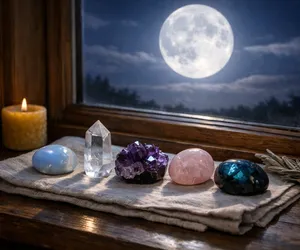
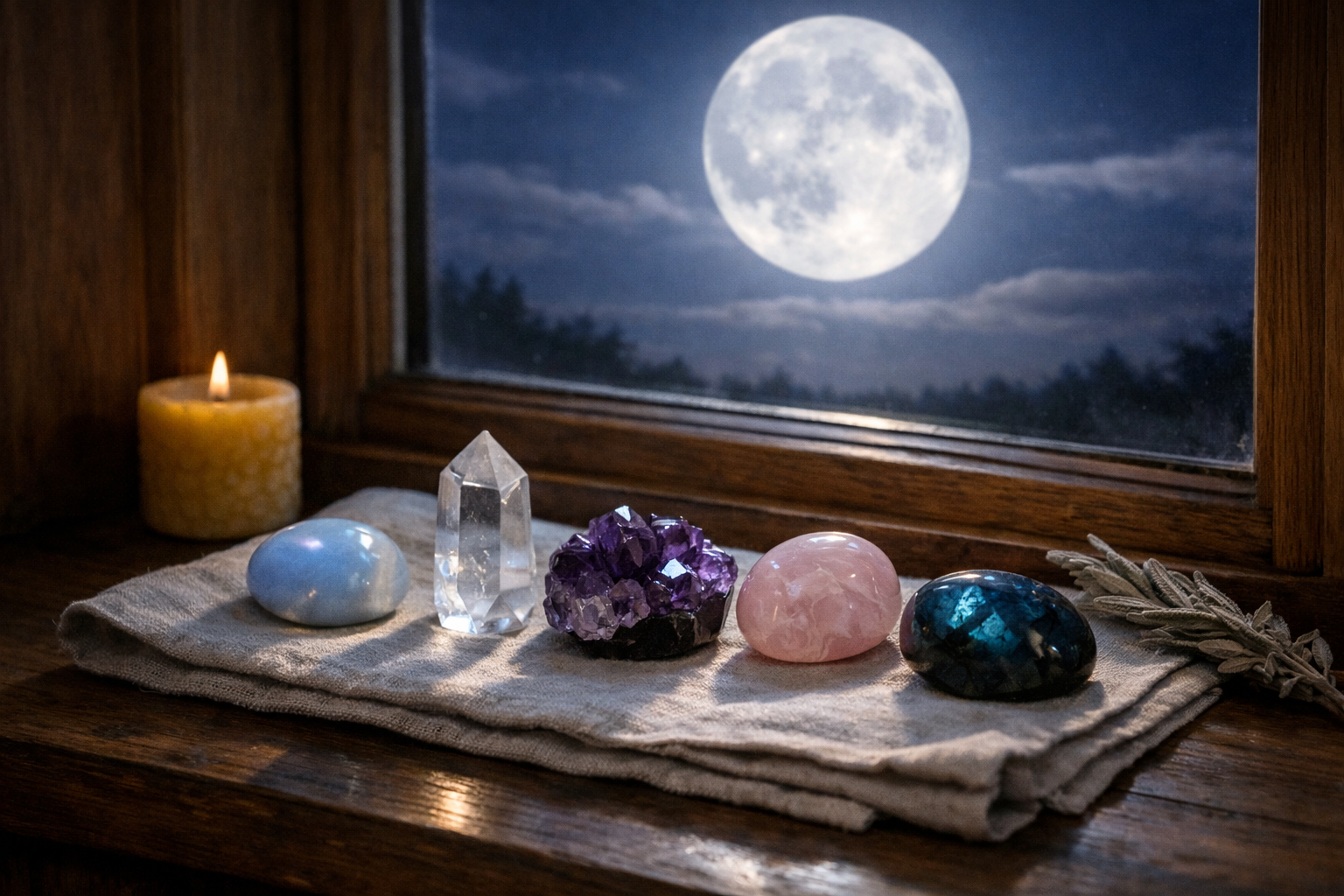
3. Set them out before dark. On the cloth, on the inside windowsill. Inside, yes: the glass takes nothing meaningful from the moonlight, and your stones face no dew, no frost, no gutter. Clear quartz in the middle, the others around it.
4. Write one intention. One sentence on the paper, present tense. Not “I would like to feel better,” but “I sleep through the night” or “I say no without explaining myself.” This is the hard step and the one that decides everything. Slide the paper under the cloth.
5. Say it out loud. Hold whichever stone pulls at you, and speak your sentence. Out loud, genuinely. “I hand you this intention, and I will do my part.” You will feel ridiculous the first three times. That passes, and it changes everything compared with merely thinking it.
6. Let the night do the rest. Lights out, go to bed. Do not get up to check. Your part of the ritual is over.
7. Bring them in when you wake. This is the step everyone neglects and the most important one in the protocol. Before the sun climbs. A night of moonlight does no harm; three hours of morning sun on an amethyst or a rose quartz, month after month, bleaches them for good. Set an alarm if you need to.
The 6 Stones to Never Set Out on a Full Moon ⚠️
Here is the part I do not see written anywhere, and the one that has caused real heartbreak in my readings. A night outdoors is not only moonlight: it is damp, dew, sometimes frost, then sun in the morning. Six families of stone cannot take it.
Selenite first — and this is the cruelest paradox of the whole ritual. It carries the name of Selene, the Greek goddess of the Moon: Swedish mineralogist J. G. Wallerius named it in 1747, in his Mineralogia. Literally “moon stone.” Yet selenite is gypsum, hydrated calcium sulfate, hardness 2 out of 10 — it is the very reference mineral for level 2 on the Mohs scale, soft enough to scratch with a fingernail. And it dissolves in water. A night of dew dulls its satin surface; a rinse destroys it slowly. The stone that carries the Moon's own name is precisely the one you must not leave out on the Moon's own night. Wipe it with a dry cloth, nothing more.
Pyrite next, for a measured and well-documented reason. Iron sulfide exposed to humid air oxidizes, producing rust, sulfuric acid, and sulfur dioxide. Museum conservators call it pyrite disease, because it spreads from specimen to specimen: the oxidation products take up several times the volume of the original mineral and burst the stone from inside. First signs are lost luster, a white or yellowish crust, and a sulfurous smell. One night of dew will not kill your pyrite, but the habit will.
Malachite. Copper carbonate, soft (3.5 to 4), and above all reactive: acidic water and vinegar dull it, salt attacks the surface. And if anyone ever offers you a direct-immersion elixir, decline — copper compounds leach into the water. Cutting dust is the genuine hazard: never sand it, never drill it yourself.
Turquoise. Porous, and usually resin-stabilized in the trade. It drinks damp, oils, and perfume, and turns a dull green. That change is permanent.
Lapis lazuli, for an indirect reason: it almost always contains pyrite inclusions (those golden flecks that make its charm) and calcite. So it inherits the weaknesses of both, plus its own porosity.
And finally, any stone that is set or glued. Bezel pendants, elastic-strung bracelets, stones cemented to a base: overnight dew seeps in, loosens adhesives, and oxidizes metal. Set out the bare stone, or leave the jewelry indoors.
For all six, the safe answer is simple: smoke, sound, or a night on a quartz cluster indoors. The symbolic benefit is identical, because it is your intention doing the work.
After the Ritual: The Three Nights That Count 🌒
What follows matters more than the ritual itself, and nobody tells you.
The full moon opens a waning phase: the Moon shrinks for the next fourteen days, down to the New Moon in Libra on October 10, 2026 at 11:50 a.m. EDT. In the traditional reading of the cycle, the waning moon is the time of what you subtract, not what you launch. That fits your intention perfectly if you framed it as a lightening — sleeping better, explaining yourself less, carrying less.
Concretely: for three days, every time your hand finds the stone in your pocket, make one tiny move in the direction of your sentence. A message sent. A “no” said. A screen switched off twenty minutes earlier. The goal is not to arrive. The goal is that the sentence does not die within the week. The Universe is a powerful ally, but it waits for us to do our part — and our part, here, fits into three days.
Keep the next date in mind too: the Full Moon in Taurus on October 26, 2026 at 12:11 a.m. EDT. Exactly one month to let your intention work before you take stock.
How Do You Know a Stone Needs Charging? 🔍
This question comes up in almost every reading, and the honest answer fits in a sentence: you will not know by looking at the stone. You will know by watching yourself.
The three signals I trust: you no longer notice it (it has become an object, you touch it without thinking); you have been through a heavy stretch with it on you; or you simply do not feel like wearing it anymore, for no reason you can name. That last one is the most reliable of all.
Be skeptical, though, of the “material” signs you read everywhere. A stone that looks dull is skin oil and dust — a soft cloth settles it. A stone that breaks took a knock; it is not a message. Do not build a spiritual reading on a household accident. You deserve better than a story you told yourself.
What If I Miss the September 26 Full Moon? 📅
Nothing is lost, and here is why. There is a full moon roughly every 29.5 days, twelve or thirteen a year. The ones after September, in Eastern Time: October 26 at 12:11 a.m. in Taurus, November 24 at 9:53 a.m. in Gemini, and December 23 at 8:28 p.m. in Cancer. Note that last one — in Europe it falls on December 24, but on this side of the Atlantic it is the evening of the 23rd.
More to the point: full moon night is not mandatory. A quartz cluster works year-round, so does smoke. The lunar date is not a condition of effectiveness — it is a shared appointment, and that is its real magic. That evening, thousands of people are setting stones on windowsills at the same time as you, each with their own sentence. That is not nothing.
If you want to go further into lunar practice, full moon wishes and the abundance ritual are the natural extension of this one: same dates, same spirit, a different wording. And if you are drawn more to attracting than to clearing, five crystals for abundance and protection covers that ground.
What This Ritual Does Not Replace 💡
I would rather say this plainly, because honesty beats enthusiasm, and because you deserve it.
A charged stone does not treat an illness, does not replace a prescription, and does not substitute for medical advice. If you are living with insomnia that has settled in, sadness that will not lift, or fatigue that rest does not touch, that is no longer a crystal question. It is a healthcare question, and there is no shame in making that call. The two do not compete, either — I have known plenty of people who do both and are better for it.
What this ritual does, it does very well: it gives you a monthly appointment with yourself, an intention said out loud, and an object in your pocket that reminds you of it when you have forgotten. The gesture more than the substance. After all these years, that is still what I find most valuable about it.
❓ Charging Crystals Under the Full Moon: Frequently Asked Questions
How long should you leave crystals out under the full moon?
One night is enough. Put them out at sunset and bring them in when you wake up, before the sun climbs. There is no bonus for leaving them out for days, and the risk goes up, because amethyst, rose quartz and citrine fade under UV in a way that never comes back.
Does the moon need to be visible to charge crystals?
No. Cloud cover changes nothing, and the moon is full whether you see it or not. On September 26, 2026, it reaches fullness at 12:49 p.m. EDT, clear sky or overcast. What you set on the windowsill is an intention and a date, not a light dose to measure.
Can you charge crystals behind a window?
Yes, and in an apartment that is what I recommend. Glass lets the moon's visible light through without taking anything essential away, and your stones face no rain, no frost, no curious animal. An inside windowsill is still the best spot in the house.
Which stones should never go outside on a full moon?
Selenite, which dissolves in water and hates overnight damp. Pyrite, which oxidizes and destroys itself from within. Malachite and turquoise, both porous. Lapis lazuli, which contains pyrite. And any stone glued or set into jewelry, because dew loosens adhesives.
Do you have to charge crystals at every full moon?
No, and that belief tires people out more than it helps. A stone you wear daily enjoys a monthly pass; a stone asleep in a drawer needs nothing. Trust use, not the calendar: you recharge what you actually use, when you feel it has been used.
Can you charge crystals in full moon water?
For quartz, yes, a few minutes is plenty. But water is the riskiest move in the whole repertoire: it dissolves selenite, rusts pyrite, soaks into turquoise and attacks malachite. If you cannot identify your stone with certainty, keep it dry. Smoke destroys nothing.
One Stone, One Sentence 🌌
This full moon falls in Aries, the sign of the clean start, three days past the equinox. If you are an Aries by star sign, the night is doubly yours: see what your yearly Aries horoscope has to say about the closing months. And if what you really want is to keep your momentum as the days shorten, four stones for the fading light pick up where this ritual leaves off, all autumn long.
Personally? I do not set out ten stones. I set out one — whichever my hand reaches for without thinking — and I write the sentence I do not want to write. It is always the right one. The other nine can wait for the next moon, and there will be another, and another after that. That is the quiet comfort of cycles.
Editor's Note: The Stone Is the Excuse, the Intention Is the PointDo not set out your whole collection on September 26. Set out one stone, write one sentence, and hold them both for three days. That is all, and it is already a lot. The Moon will be full again on October 26 without asking our opinion; until then, our part of the walking is made of small repeated gestures.
Not sure which stone is yours, or what sentence to write that night? A reader can ask the right questions in a few minutes — the ones we carefully avoid asking ourselves. |
Stones and lunar cycles decide nothing on your behalf. They illuminate, they remind, they accompany: your free will stays entirely yours. Charging your crystals under the full moon will not solve a single problem by itself — but the appointment you keep, the sentence you dare to write, the month you choose to look at squarely, those are things nobody can do for you. Which is exactly where their power comes from.
Know someone whose crystals have been asleep in a bowl since last spring? Send them this before September 26. There is a night worth catching, and a piece of selenite worth saving. 🌕
Read next:








Did you like this article?
Want to know more 🤔 ?
Write directly to the authorMadisonCarter !
Ask Madison a question
Want to share your thoughts? Leave a comment