The 5 letting-go rituals and their elements 🌊🧂📦🔥🌬️
Each ritual rests on a gesture that traditions around the world tie to the end of the year. You'll find them all, in order, in the step-by-step below. Read them first: one may call to you more than the others.
1. Water that rinses: washing away what weighs 💧
Element: water · for: the emotions of the year · 10 minutes
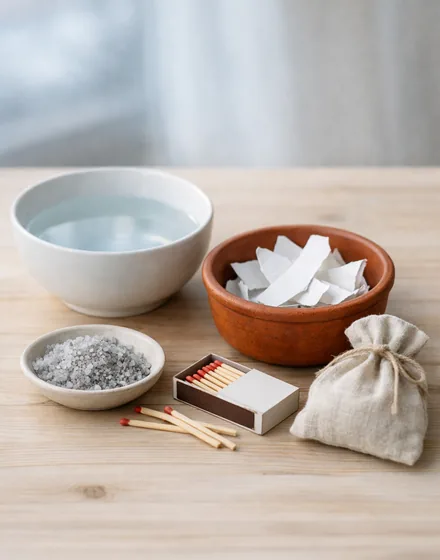
Water carries things away. This first ritual is for what tightens your heart: a disappointment, anger, tears held back. You dip your hands in a bowl of water, name what you're letting go of, then pour the water outside or down the sink. It's Puerto Rico's midnight bucket of water, scaled down to a kitchen; in Naples, water thrown from the balcony stands for the tears of the year.
Say: “What I have carried, I entrust to the water. I keep what it taught me.”
Sources: Welcome to Puerto Rico, AAA Northeast Magazine; Storie Napoli.
2. Salt that absorbs: clearing the threshold 🧂
Element: earth · for: the atmosphere at home · 5 minutes, then 3 days
Salt is the great purifier of traditions. In Japan, Shinto uses it for purification, and small cones of coarse salt, called morijio, are placed at the entrance of homes and shops and renewed regularly. Here, a small dish of coarse salt by your front door absorbs, for three days, whatever has gone stale at home: tension, arguments, restless nights. Then you throw it away, never reusing it.
Sources: Wikipedia “Harae”; JapanUp! magazine; Green Shinto.
3. Decluttering that lightens: making room 📦
Element: space · for: what clutters · 15 to 20 minutes
An object you no longer use still holds the imprint of the moment it arrived. Decluttering is the most concrete of the five gestures: one drawer, one shelf, one bag, and seven items that leave. You give them away, recycle them or throw them out. The Scots make it a Hogmanay duty, right down to borrowed items, which go back to their owners before midnight. In Naples, people used to throw old things out the window, a custom now abandoned for good reason.
Say: “I free this space. What needs to come will find a place to land.”
Sources: Forever Edinburgh, Time Travel Britain, ScotlandShop; Corriere Azzurro, Bigodino.
4. Fire that transforms: burning the list 🔥
Element: fire · for: thoughts that go round in circles · 10 minutes
Fire doesn't destroy, it changes the state of things. This ritual burns a list: what you no longer want to carry, a few words per line. In Ecuador, on December 31, the años viejos are burned at midnight: effigies made of old clothes stuffed with paper or sawdust that stand for the year that's leaving. They must burn completely, or else, people say, the troubles come back. Your list fits in a small dish, and it's in watching it turn to ash that you feel something loosen.
Sources: USC Folklore Archives; Ecuador Times; Laylita's Travels.
5. Breath that releases: breathing out the year 🌬️
Element: air · for: tension in the body · 5 to 10 minutes
The last ritual asks only for an open window. In Japan, on New Year's Eve, Buddhist temple bells ring 108 times, one strike for each of the 108 earthly attachments that, in Buddhism, trouble the mind: this is joya no kane. You'll do the same with your breath, in your own way: one long exhale for each thing you let out. And if you keep seeing 18:18 on the clock these days, the mirror-hour tradition reads it as a call to let go.
Say: “I breathe out what is over. I breathe in what begins.”
Sources: Wikipedia “Joya no Kane”; Asian Art Museum, San Francisco.
✦














Did you like this article?
Want to know more 🤔 ?
Write directly to the authorMadisonCarter !
Ask Madison a question