The 4 Gestures That Honor a Scar ✨
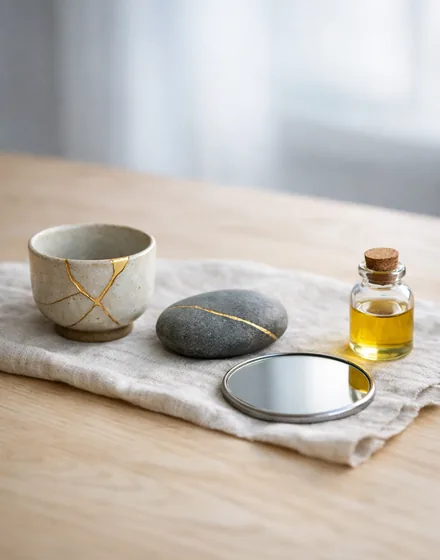
This ritual needs very few objects. Each gesture works through one sense, and each applies to a scar on the body as much as to a scar on the heart. Read them before you begin, so you know where you're headed.
1. The Gaze: Seeing Without Judging 👁️
The mirror · for body and heart · 2 minutes
We often avoid looking at our scars, or we look at them harshly. The first gesture is to truly see them, with the eyes you'd have for someone you love. For a scar on your body, a small mirror is enough. For a scar on your heart, close your eyes and replay the scene from a distance, like a movie whose ending you already know: you're here, today, to look at it.
2. Touch: Making Peace Between Hand and Mark 🤲
The oil · only on an old, fully closed scar · 3 minutes
Your hand recognizes what your eyes have seen. On an old, fully closed scar, place a drop of plant oil or your usual lotion and massage slowly with your fingertips. For a scar on your heart, simply rest your open hand flat on your chest and breathe beneath it. This isn't a treatment. It's a way of telling that part of you that it's no longer kept at a distance.
Say: “I see you, and I won't hide you anymore.”
3. Words: Telling What It Taught You 🗣️
Your voice · one sentence per scar · 3 minutes
A scar that's never named stays in the shadows. The third gesture gives it words, out loud, in one or two sentences: what it tells and what it taught you. No need to explain everything or write anything down; one honest sentence is enough. Often it's the second half, “it taught me…”, that surprises the person saying it.
4. Gold: Marking the Repair, Kintsugi-Style 🪙
The pebble and the gold marker · one line per scar · 5 minutes
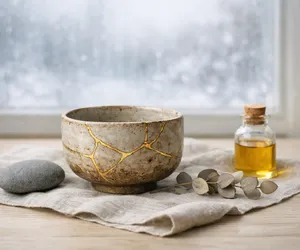
Kintsugi (“golden joinery” in Japanese) mends ceramics with urushi lacquer mixed with or dusted in powdered gold. It's tied to the bowls of the tea ceremony, and an often-told story places its birth in the late 15th century, when the shogun Ashikaga Yoshimasa is said to have received a Chinese bowl repaired with crude metal staples. In this ritual you aren't mending a bowl: with a gold marker, you draw a line on a smooth pebble, one for each scar you honor. The pebble keeps every passage in gold.
“There is a crack in everything, that's how the light gets in.” Leonard Cohen, Anthem (1992)
Sources: Freer Gallery of Art (Smithsonian), “Golden Seams” exhibition (2008-2009); Britannica, which notes the exact origin is unknown.
✦














Did you like this article?
Want to know more 🤔 ?
Write directly to the authorMadisonCarter !
Ask Madison a question