Judgement (XX): Someone Comes Back for You 📯
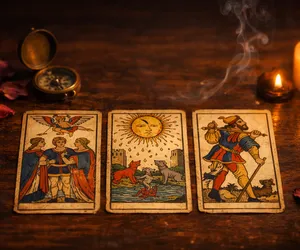
An angel sounds a trumpet, three figures rise out of the earth and lift their heads. It is the most literal card in the deck on this subject, which is why it opens the list. Judgement in the Tarot de Marseille is the arcanum of the call that is heard, of what surfaces after being buried, of the file you thought was closed reopening on its own.
What It Announces in Practice
In love, its translation is direct: someone comes back. Sometimes literally — a message from a person you hadn’t heard from in two years, a chance meeting in a city where neither of you lives, an invitation to a wedding where you knew perfectly well who would be present. Sometimes figuratively, and that is even more interesting: a new person arrives, and they wake up exactly what an older one left hanging. Same way of laughing, same gap in the same story.
Judgement has a feature few arcana share: it requires no action on your part to trigger. The figures on the card are not digging their way out, they are being lifted. On a question of the heart that is a valuable indication — what this card announces arrives without you having to force it, and attempts to speed the movement up generally produce the opposite.
Its Bright Side: A Real Second Chance
When this card falls in a future position, it says a bond is not dead, only asleep, and that it will wake on its own. It is a generous card that asks almost nothing: just that you open when someone knocks. It also carries an idea of forgiveness that is not naivety — Judgement does not repair the past, it gives you permission to set it down.
It is the card I most like to see come up for someone who walks in convinced they have “missed their chance.” There is no single window in love. There are cycles, and Judgement says so more plainly than any other card in the deck.
The Trap of the False Return
Its warning lies elsewhere, and it is serious. Judgement does not sort. It brings up what needs to come up, including what you buried for very good reasons. An ex coming back is not automatically a karmic love: sometimes it is just an ex who is bored. The difference shows in one thing — a real karmic return makes you grow, a false one drops you back exactly where you already were. If the conversation picks up word for word where it stopped, that is not Judgement, that is a loop.
Your move: don’t reply within the hour. Let three days pass, and see what it does to you on the third. Day-one emotion proves nothing at all; day-three emotion does. Judgement rewards those who listen to the call, not those who jump.
The Wheel of Fortune (X): The Meeting You Never Planned 🎡
A wheel, figures clinging to it, nobody at the controls. The Wheel of Fortune is the arcanum of cycles and of chance that isn’t quite chance. It is the card that says something is moving without your permission, and that the movement had already started by the time you noticed.
The Card of the Arrival, Not the Relationship
On a karmic love question, it is the card of the encounter itself. Not the feeling, not the story: the arrival. It comes up when someone is about to enter your life by a road you would never have mapped — a work trip, a friend of a friend, a cancelled appointment that frees another, a queue. Clients almost always tell me the same sentence afterwards: “normally, I shouldn’t even have been there that day.” That’s it. That’s the Wheel.
What It Says About Duration
It adds a valuable nuance on timing. The Wheel turns: it does not stop because the meeting happened. A bond announced by this card often arrives fast, very fast, and it can leave just as fast if no steadier card backs it up. When it comes out alone, without Judgement or the Lover beside it, I always give the same warning: this is a passage, not an installation. That is not bad news, it is information about duration — and a short story is not a failed one.
Why It Rewards Availability
The Wheel rewards those who are available, not those who wait. A karmic encounter does not come looking for you in your living room on a Sunday in November. It needs you to go out, to say yes to an invitation that already bores you, to change your route. I know that is a mundane thing to read. It is nonetheless what I observe most often: the Wheel shows up for people who have just agreed to something.
Your move: say yes, this week, to exactly one invitation you would have refused on reflex. One is enough. The Wheel does not need you to upend your life, it needs an opening.
The Lover (VI): The Bond That Forces a Choice 💞
A young man, two women, an archer above. The card that bears the name of love is, in a tarot irony, the card of choice — and that is precisely what makes it the third card of karmic love. The Lover in the Tarot de Marseille does not say “you are going to love.” It says “you are going to have to decide, and it is going to cost you something.”
The Most Reliable Signature of a Karmic Bond
It is a better indicator than intensity, by a wide margin. An ordinary love adds itself to your life. A karmic love reorganises it: it puts you in front of a decision you have been postponing for years. Stay in a city or leave it. Admit what you actually want or keep pleasing people. Accept being loved when you had carefully arranged your existence so as not to be.
That is why the Lover is the card I look at first when someone asks me whether their meeting “really counts.” If nothing in your life has to move for this story to exist, it may well be lovely, but it is probably not karmic. Reading the right spread for your question matters here more than anywhere else.
The Detail Everyone Forgets on This Card
The central figure looks at neither of the two women. His head is between them. It is the card of indecision as much as of choice, and in a karmic reading it often says something hard to hear — “you already know, and you are dragging it out.” The archer above has already fired. The arrow is in the air while you are still hesitating, and that may be the truest image tarot offers on the subject of wasted time.
Its Bright Side and Its Warning
When the Lover comes out with Judgement, it is one of the finest combinations in the deck on a question of the heart: someone returns, and this time you choose for good. When it comes out with the Wheel, it is a meeting that will demand a fast commitment — and haste is not always a mistake, whatever people say.
Its warning fits in one line: not choosing is also a choice, and it is the most expensive of the three. Your move: write down what you lose in each of the two options, not what you gain. The gains are known, they are what makes us daydream. It is the losses that decide, and we rarely look at them squarely.
Two-Card Combinations and What They Say 🎴
A single card says almost nothing. It is the sequence that speaks, and the pairs below are the ones I meet most often on a question of connection. They are worth more than any card-by-card interpretation.
| The pair | What it tells you | How solid |
| Judgement + Lover | A return, and this time you decide | Very solid |
| Wheel + Lover | A fast arrival demanding commitment | Solid if you choose |
| Judgement + Wheel | The past returns by an unexpected road | Intense but mobile |
| Wheel + Moon | A blurry meeting, a déjà-vu to verify | Let it ripen |
| Lover + Devil | The choice is blocked by an attachment | Work on that first |
| Judgement + Devil | A return replaying the old dependency | Refuse without guilt |
The Most Promising Pair: Judgement and the Lover
Something reopens, and this time you have the means to decide. It is the combination that most often accompanies reunions that hold, because it pairs movement with discernment. It does not promise ease: it promises that the decision genuinely belongs to you, which was not the case the first time around.
The Most Deceptive Pair: Wheel and Moon
Everything moves very fast and you can see nothing. The emotion is authentic, the reading is not yet. This is exactly the configuration where people make in three weeks a decision they spend three years undoing. When these two come out together, change nothing irreversible before the third month.
The Pair That Calls for a Stop: Lover and Devil
The choice is on the table and something is preventing you from making it. That something is almost never the other person: it is an older attachment, a loyalty, a fear of emptiness. The useful reading here is not “should I stay?” but “what am I attached to, so strongly that I cannot decide?”
And If None of the Three Shows Up?
Then the answer is probably no, and that is information like any other. An absent signal is not a failed reading: it is a reading telling you the live subject is elsewhere. Plenty of love consultations reveal a work or family question taking up all the space. The cards don’t answer the question you asked, they answer the one that matters.
The Two Cards That Change the Whole Reading 🌑
Three cards announce. Two others qualify. If you don’t look at them, you risk reading a blessing where there is a warning, and that is the mistake I repair most often.
The Moon (XVIII): The Déjà-Vu and the Fog That Comes With It
The Moon in the Tarot de Marseille is the card of the past resurfacing, of the unconscious, of things felt before they are understood. It very often accompanies karmic bonds, so much so that people mistake it for a fourth card of announcement. It is not, and the nuance matters: the Moon does not say the person is arriving, it says you are not seeing them clearly.
Two dogs howl, a crayfish climbs out of the water, the light is faint but real. Translation: the sense of “I have lived this before” is authentic, and it is misleading at the same time. It comes from an old layer that recognises a pattern — sometimes the right person, sometimes simply the same type of person who once hurt you. When the Moon frames the three karmic love cards, wait three months before any irreversible decision. Not out of moral caution: because the Moon always ends up rising, and what you see in the morning is not what you thought you saw at night.
The Devil (XV): The Bond Exists, But It Ties
This is the most misread card in the deck, and the most useful one here. The Devil announces no misfortune: it points at bonds. Two small figures tied to the plinth, with ropes loose enough to be lifted off — that is the whole message of the card, and hurried readers routinely invert it.
In karmic love, the Devil appears when the intensity comes from dependency rather than recognition. Passion that keeps you from sleeping, break-ups that don’t survive three days, the feeling that you cannot do otherwise. This is not a moral judgement: plenty of genuine karmic stories pass through here, and some come out transformed. But it has to be called by its name. If the Devil shows up alongside the three cards, the work is not to find the person, it is to understand why you attach in that way. The card does not condemn, it shows where the ropes are — and reminds you that they lift off.
The Cards People Mistake for These Three 🃏
Three other arcana are regularly presented as karmic love cards. They are not, and knowing why sharpens the reading considerably.
Death (XIII): An Ending, Not an Encounter
Death cuts. It settles, it closes, it clears what was lingering. On a question of the heart it announces an exit far more often than an entrance — and when it precedes the three cards in a line, it simply says room has to be made before anything can arrive. Mistaking it for an announcement of a meeting makes people wait at the wrong moment.
The Star (XVII): Sweetness, Not Fate
The Star is a beautiful, slow card. It speaks of relief, of confidence returning, of generosity circulating. That is excellent news in love, but it carries no karmic charge: it describes a climate, not an appointment. A great many lovely, ordinary stories come up under this card, and there is nothing diminished about that.
The Hermit (IX): Waiting, and What It Hides
An old man, a lantern, one step at a time. The Hermit is often read as “a pause before someone arrives.” In practice it mostly says that you are standing still and calling it destiny. That is uncomfortable to hear, and very often accurate: waiting is not the same thing as being on the way.
The 3-Card Spread to Check for Yourself 🕯️
You need no silk cloth and no twenty years of practice. Three cards are enough, and the protocol fits into four steps. I have used it as is for years on questions of connection, and it works with any of the spreads you already know — including the most powerful tarot deck you happen to own.
1. Ask the Real Question, Not the Polite One
Write it down before you shuffle. “Will I meet love?” will give you nothing: that is an expectation, not a question. “What in me is ready, or not ready, to receive this kind of bond right now?” is a question. The quality of the reading comes from there, not from the cards — which is the best news in this article, because that part depends entirely on you.
2. Draw Three Cards, Face Down, Left to Right
Card 1: what is already here — the ground, what you carry before any meeting. Card 2: what is arriving — the nature of the bond approaching, if it is approaching. Card 3: what it asks of you — the price, the effort, the thing you give up. Do not draw a fourth card to find out “when.” Tarot answers dates badly and movements very well.
3. Read the Line, Not the Cards One by One
This is mistake number one, across every subject. The Wheel in position 2 followed by the Lover in position 3 is not “a meeting and a choice,” it is “someone will turn up unexpectedly and force you to settle a question you have been dragging.” Look at where the figures are looking, too: who has their back to whom? The answer is often there, and it is in no book.
4. Write It Down, Date It, Close the Deck
Write the three cards and the date in a notebook, then put the deck away. Read it again in three months. That is the only honest way to know whether your reading was accurate, and the only safeguard against the temptation to redraw until the answer suits. If you want to practise without a deck, the free love tarot lets you make the gesture online before making it with real cards.
The Karmic Axis Also Shows in the Sky 🌙
Tarot is not alone on this ground, and it would be dishonest to pretend otherwise. Astrology has its own tool for the same question, and it is remarkably precise: the lunar nodes. The south node describes what you already know how to do, sometimes too well; the north node, the uncomfortable direction your life keeps pushing toward.
What makes the tool interesting here is that a karmic bond very often lands on that axis. You meet someone who embodies precisely what you avoid — and the relationship becomes an apprenticeship rather than a comfort. It is the same grammar as the Lover: you are not choosing between two people, you are choosing between two versions of yourself.
The Scorpio profile describes this mechanism well, because it is the sign that lives transformative bonds most naturally — the ones that leave nobody intact. You don’t have to be a Scorpio; that area of the chart can be heavily occupied in anyone, and the pattern is recognised instantly. For the wider context of the period you are in, the Scorpio yearly horoscope fills in the background, and the signs that a karmic cycle is ending are worth reading alongside it.
Tarot and astrology do not contradict each other here, they overlap. When the three cards come out and the nodal axis is active in the chart, the indication is considerably more solid than with either tool alone. That is the only stacking I recommend: not three readings in a row, but two different angles on the same question.
Your Questions About the Karmic Love Cards ❓
Which Card Announces a Karmic Relationship?
There isn’t just one, and be wary of anyone who tells you otherwise. Three major arcana carry the signal in the Tarot de Marseille: Judgement (XX) for the return and the call, the Wheel of Fortune (X) for the unplanned meeting, and the Lover (VI) for the choice it imposes. What counts is their joint appearance, not their isolated presence: a Wheel of Fortune on its own announces a change, not necessarily a love.
Does Judgement Always Mean an Ex Is Coming Back?
No, and that is the most widespread and most disappointing reading. Judgement announces a return in the broad sense: a person, but also a situation, a desire, a part of yourself you had set aside. In roughly half the cases I see, what returns is not someone from the past but someone new who wakes an old story. The feeling is identical, the origin is different.
Can You Avoid a Karmic Love?
You can avoid the relationship, you can’t avoid the lesson. That was my grandmother’s formula and I have not found better. Refusing a karmic bond is perfectly legitimate, especially when the Devil is on the table: nobody owes you a painful story in the name of destiny. It is simply that the pattern the meeting came to illuminate does not disappear — it will present itself again in another form.
How Long Does a Karmic Relationship Last?
Tarot gives no duration, and no card carries a calendar. What can be read is the nature of the passage: a lone Wheel of Fortune indicates a fast and mobile bond, Judgement alongside the Lover indicates something that settles, and the Devil indicates a cycle that repeats until it is named. The useful question is not “how long” but “what does it shift.”
Should You Redraw if You Don’t Like the Answer?
Technically yes, usefully no. A second immediate draw on the same question mostly measures your anxiety. Good practice is to note the reading, let at least a week pass, then reframe the question from a different angle if the subject is still live. Three draws in a row don’t give three opinions: they give noise.
Can Tarot Tell You Who the Person Is?
No. It can describe an energy, a temperament, sometimes a life situation — never a first name, a face, or an address. A reader who describes in detail someone you have not yet met is telling you a story, not giving you a reading. The cards show tendencies and possibilities, and that is already considerable.
What These Three Cards Do Not Say 🚫
They Give No Date
Judgement, the Wheel and the Lover carry no calendar. They do not say the meeting will happen in February, or that the person is six foot tall. If your reading handed you a date, you added it — and that is very human, since the first thing anyone asks the cards is almost always “when.”
They Promise No Happiness
This is the costliest misunderstanding in the karmic vocabulary: karmic does not mean destined, and still less good for you. A bond can be profoundly transformative and profoundly exhausting. The cards qualify intensity and movement, not comfort. A relationship that teaches you something essential may well not last, and not lasting doesn’t make it less real.
They Decide Nothing for You
Nobody leaves someone because the Wheel of Fortune came up, and nobody should stay for the same reason. Tarot is a companion for personal development: it lights the windscreen, it does not drive the car. If you are going through a situation that genuinely puts you in difficulty, the right address is a person, not a deck of cards. The type of partner you keep attracting is a pattern worth examining with someone.
A Card Lights the Way, It Doesn’t Marry You 🌟
The three cards of karmic love close no door and open none on your behalf. The future is never entirely fixed: what Judgement, the Wheel of Fortune and the Lover describe are tendencies and possibilities — a movement under way, an availability, a decision approaching. You remain the master of your path, and that is a good thing, because a meeting that didn’t engage your freedom wouldn’t be worth much.
If you take away one thing, take this: these cards speak less about the other person than about you. They describe the state you are in at the moment somebody knocks. That is why the same spread, drawn six months apart, does not tell the same story — and why the most useful card is almost never the one you were hoping for.
Editor’s note: recognising is not guessingDon’t draw ten times this week. Draw once, write the three cards down, and ask yourself the only question that counts: what is this bond asking me to look at? The readings that change something are never the spectacular ones, they are the ones people actually apply.
And if the card that unsettles you is precisely the one you can’t read on your own, having a reader go through your spread will save you months of circling the subject. |
Do you know someone who has been repeating for two years that “with him it’s different, I can’t explain it”? Send them this article, and especially the paragraph on the Devil: it will probably say what you haven’t dared to.
Read more:








Did you like this article?
Want to know more 🤔 ?
Write directly to the authorAvaOf Light !
Ask Ava a question