

Full Moon in Taurus on October 26, 2026: What It Reveals
On Monday, October 26, the Hunter's Moon lights up Taurus. When to see it, what it stirs up, and what it reveals for you, sign by sign.
Last updated by Ava Of Light
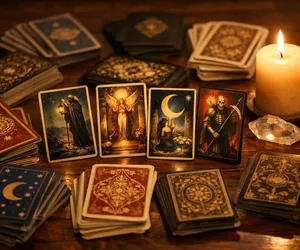
It's THE question I get asked non-stop: "Which is the most powerful tarot?" As if one deck, somewhere out there, pulled better cards than all the others. I'll be straight with you right away: the real answer will probably surprise you. But before we get there, let's properly compare the big decks, Marseille, Rider-Waite, Thoth, Belline, and figure out where their strength actually comes from.
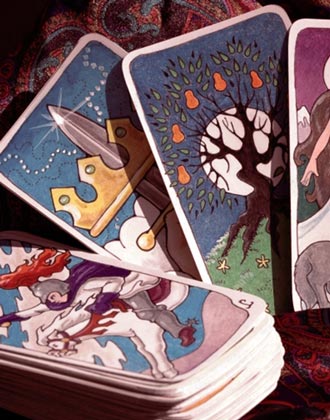
Today’s Love Tarot — Instant Answers
Think of your person or your burning question, take a deep breath, and reveal today’s Tarot message
When people hunt for the most powerful tarot, they're actually mixing up several very different things. The richness of the symbols? The precision of the answers? The esoteric depth? The ease of getting your intuition to speak? Each of those criteria points to a different deck.
The engineer in me never fully left, and here it's genuinely useful: before I judge any deck, I ask what job I actually want it to do. A deck built for lightning-fast, concrete answers isn't failing when it struggles with a tangled emotional question, it's simply the wrong tool for that job. So the honest version of the question isn't "which deck is strongest?" but "strongest at what, and for whom?" Keep that reframing in your back pocket; it quietly settles half the debate before it even starts.
When I started out seven years ago, fresh from an engineering career, I figured a "strong" deck would make me a better reader. My grandmother, who handed all of this down to me, just smiled: "A beautiful violin doesn't make the musician." In other words, the power doesn't sleep inside the cardboard and the ink; it's born from the meeting between a deck and the person reading it. Hold on to that idea, we'll come back to it at the end.
In the meantime, let's look at the five decks that always come up when the talk turns to power. Each one is "the most powerful"... for one very specific use.

Before we dig into the detail, here's the map of the territory. Keep this table within reach: it sums up the great strength of each deck and the profile it suits best. We'll unpack each one right after.
| The deck | Its great strength | Most powerful if you're after… |
| Tarot de Marseille | Tradition and pared-down symbolism | Depth and rigor |
| Rider-Waite-Smith | Fully illustrated minor arcana | Intuition and easy reading |
| Thoth Tarot | Esoteric density (kabbalah, astrology) | Advanced esotericism |
| Belline Oracle | Explicitly themed cards | A clear, direct reading |
| Petit Lenormand | Concrete, predictive answers | Facts, down-to-earth answers |
A quick reminder before we start: a true tarot counts 78 cards (22 major arcana and 56 minor). Two of the decks on this list, the Belline and the Lenormand, are in fact oracles, we file them in the same broad family, but their structure is different. I'll come back to that, it matters.
Decipher the wisdom of the cards 🔮
👉 Explore your tarot journey →
🔮 Let the ancient wisdom of tarot guide your path
If you ask me for my favorite deck, this is the one. The Tarot de Marseille is the oldest Western tarot still in use today: its earliest known copies go back to the 17th century, and the model settled into a standard form in the 18th. Which is to say it has crossed the centuries without picking up a single wrinkle.
Its signature? Major arcana with pared-down, almost raw symbols, and minor arcana that aren't illustrated: batons, cups, swords and coins laid out geometrically, with no little scene. A fun little detail for the curious: in the traditional Marseille, Justice carries the number VIII and Strength the XI, the reverse of most modern decks.
Why is it so powerful? Because it doesn't do the work for you. With no ready-made scenes, you're the one linking the symbols, the colors, the gazes. That demand builds a deep, methodical, almost architectural reading. No wonder it stays the reference for lovers of occult tradition. To get comfortable with its cards, start with a free Tarot of Marseille reading.
Its limit? Those same abstract minors often throw you at the start: with no telling image, you have to know your symbols. It's a deck you earn a little.
My advice: pick it if you love learning in depth and rigor doesn't scare you off. It rewards patience like no other deck on this list.
Here's the most widely used deck in the world, and by a huge margin. Published in London in 1909-1910, it's the work of Arthur Edward Waite for the design and of artist Pamela Colman Smith for the illustrations: a creator long left in the shadows, even though her line is what gives the deck all its magic.
Its revolution comes down to one thing: the minor arcana are fully illustrated. Where the Marseille lines up five cups with no scenery, the Rider-Waite paints a little scene that already tells a story. Every card, major or minor, becomes a talking image.
Why is it so powerful? Because it puts your intuition to work effortlessly. You look at a card, an emotion rises, an association surfaces: the message is right there, almost obvious. That's why it's so often recommended as a first deck. If you're still torn over yours, this guide on which tarot deck to choose will help you settle it.
Its limit? Those very expressive images can also box you in: you sometimes lean on the illustrated scene without digging into the symbol. And a little trap for the purists: here Strength carries the number VIII and Justice the XI, exactly the reverse of the Marseille.
My advice: go for it if you're a beginner or you love a lively, image-rich reading. It's the most accessible deck without ever being shallow.
Now we step up to the big leagues. The Thoth Tarot was designed by the notorious occultist Aleister Crowley and painted by Lady Frieda Harris between 1938 and 1943 (it wouldn't be published until 1969). This isn't a deck you pick up lightly.
It's the densest tarot there is: it weaves together kabbalah, astrology, alchemy and hermetic magic. Every card layers several levels of meaning on top of one another. Crowley even renamed some of the arcana: Strength becomes "Lust," Justice becomes "Adjustment." We're not quite in the same world anymore.
Why is it so powerful? Because it doesn't just answer: it opens doors. For anyone drawn to symbolic correspondences and esoteric systems, it's a bottomless mine. You don't learn it by heart; you explore it, year after year. I have a friend mad about astrology who'd never clicked with a classic tarot: the day he opened a Thoth and saw each card tied to a planet and a sign, everything lit up for him. The best proof that the "right" deck is the one that speaks your language. If you like comparing systems, this complete guide to tarot decks maps out the whole field.
Its limit? That very richness. Without solid grounding in esotericism, you drown fast. It's clearly not the deck to begin with.
My advice: save it for later, once tarot has made you want to go further into the symbolism. It's a study companion, not a Sunday game.
Change of family: the Belline isn't a tarot but an oracle. Its 53 cards were drawn in the 19th century by a renowned cartomancer nicknamed the Mage Edmond. The deck wouldn't be published until 1961, under the name of the seer Belline, who rediscovered it and saved it from oblivion.
Its quirk? A planetary structure: the cards are organized around the seven traditional planets, and each one carries an explicit theme: "Destiny," "Love," "Betrayal," "Luck"…
Why is it so powerful? Because it speaks immediately. It's far simpler to connect with a "Separation" card than with a five of swords you first have to decode. When the "Luck" card lands right next to the "Union" card, the message needs almost no commentary. For a clear, fast, jargon-free reading, the Belline Oracle is formidably effective, hence its huge popularity across the French-speaking world.
Its limit? Its strength is also its weakness: the explicit themes leave less room for the deep nuance of a Marseille arcanum. And it stays hard to find outside French-speaking countries.
My advice: perfect if you want crystal-clear answers without spending months learning a system. It's often the first oracle people adopt alongside a tarot.
Last in our selection, and no small player for fans of down-to-earth predictions. The Petit Lenormand is a 36-card illustrated deck with very concrete images: a key, a coffin, a bouquet, a letter, a rider…
A little historical correction, because the legend dies hard: Marie-Anne Lenormand, the famous seer of Joséphine and Napoleon, never used this deck. It was published after her death and derives from a German parlor game, Das Spiel der Hoffnung ("the Game of Hope"); her prestigious name was tacked on to sell it better. Even back then, marketing was on the job!
Why is it so powerful? Because it's ruthlessly precise on the concrete. Where the tarot explores the "why," the Lenormand answers the "what" and the "when": facts, people, situations. In practice, you read the cards two by two: the Key next to the Heart signals a love story unlocking, the Rider next to the Letter, news arriving fast. It's that reading in pairs that makes the deck so telling. For factual prediction, hard to do better.
Its limit? It's less introspective. If you're trying to understand your deep emotions, a tarot will speak to you more. And for questions of timing, a yearly tarot reading stays an excellent complement.
My advice: adopt it if you love direct answers and concrete situations. It works wonders alongside a more symbolic tarot.
You've got it: there's no single winner, but an ideal deck for your profile. Here's how I sum it up for the people who consult me:
And nothing says you have to pick just one. Most readers juggle several decks depending on the question asked: a tarot to explore, an oracle to pin things down. It's a bit like choosing the right tarot spread for your question: every tool has its moment.
The question pops up the moment you name the Belline or the Lenormand alongside the Marseille. The difference isn't about power, it's about nature. A tarot rests on a fixed structure of 78 cards and a codified symbolism: it excels at exploring a situation in depth, with all its nuances. An oracle has neither a set number of cards nor a universal structure: each deck invents its own themes, often more direct.
Put another way: the tarot reads like learning a language, the oracle lands like a conversation that gets straight to the point. Neither is "superior"; they answer different needs. Plenty of practitioners, me first among them, keep both within reach: the tarot to dig, the oracle to clarify or confirm a message. If the itch to try reading your own cards is getting to you, start with the deck you're most spontaneously drawn to: it's always the best place to begin.
Here we are, at that surprising answer. Over time, I've landed on a very simple conviction: the most powerful tarot isn't a brand, it's the one you truly master. A deck reputed to be "strong" in hesitant hands will say less than a plain deck in attentive ones.
Power is cultivated, a bit like taming an instrument:
People often expect me to hand them a shortcut here, some secret shuffle or a lucky phase of the moon. There isn't one, and honestly that's the good news: it means the power was never locked away in a technique you don't have. It's built quietly, one honest draw at a time, and it's available to anyone willing to show up regularly. The reader I am today isn't the one who stumbled on a magic deck; it's the one who kept turning the same cards over until they started talking back.
That's the whole secret: a tarot isn't a crystal ball that decides in your place. It's a mirror and a compass. It lights up tendencies and possibilities, but the future is never fully set, it's built out of your choices.
No, and I insist, because the belief is stubborn. A pricey, ancient or supposedly "charged" deck holds no extra virtue over a store-bought one you know well. I've seen shattering readings done with a dog-eared deck bought secondhand, and dull draws made with gorgeous collector editions.
What counts is your familiarity with the images and the regularity of your practice, not the value of the object. Treat yourself to a beautiful deck if it makes you happy: pleasure feeds the practice too. But never count on the cardboard to do the work in your place; that part is your job.
My grandmother read for the whole neighborhood with a deck so worn the corners had gone soft, and nobody ever left her kitchen table unmoved. That image has stayed with me: the magic was in her attention, her questions, the silence she let settle before she spoke, never in the price tag. If a gorgeous edition makes you want to sit down and practice, buy it for that reason alone. Just don't expect the paper to carry the reading; that's on you, and it always will be.
So, which is the most powerful tarot? The one that speaks to you, the one you take the time to tame, the one in whose hands you feel just right. Marseille, Rider-Waite, Thoth, Belline, Lenormand: each is a different doorway into the same thing: a dialogue with yourself.
Don't go looking for the deck with magic powers: look for the one you actually want to spend time with. The cards point the way, but you're the one walking it. You stay, always, the master of your own journey. 🌟
The editor's note: the power is in your handsNo tarot is magically stronger than another: the real power comes from the bond you weave with your cards. Pick the deck that draws you in, tame it, and let your intuition do the rest. Ready to jump in? Try a free love tarot reading right now. |
Know someone who's been torn for months between several decks? Share this article with them: they'll finally choose theirs with full clarity. 🃏

Article presented by
Ava Of Light
"As a spiritual guide, I specialize in one thing: the magic of love. I combine intuitive Tarot readings with practical spellwork to help you transform your love life. We'll use the Tarot to diagnose the spiritual opportunities and blockages, and then use focused spells to manifest your desires. My go..."
Read on
Begin Your 2026 with Confidence
On Monday, October 26, the Hunter's Moon lights up Taurus. When to see it, what it stirs up, and what it reveals for you, sign by sign.
Pisces, Sagittarius, Taurus: according to tradition, Jupiter and Venus, the planets of luck, are at home there. The ranking of all 12 signs.
A relationship going in circles, a loyalty that wears you out, a past that sticks to your shoes? In 2027, you finally cut it. I'll tell you which one, and when.
In 2027, you don't slam the door: you close it, properly. I'll tell you which chapter your sign will end, in which season, and what opens up behind it.
Mercury in Scorpio turns retrograde Turn inward with courage: beneath the surface of every feeling, your soul is whispering the truth that sets you free.

Venus transits from Scorpio into Libra Let your heart seek harmony without losing its depth: today, love becomes a sacred bridge between your truth and the beauty you are ready to receive.


Did you like this article?
Want to know more 🤔 ?
Write directly to the authorAvaOf Light !
Ask Ava a question