Death (XIII): The Card That Changes Everything 💀
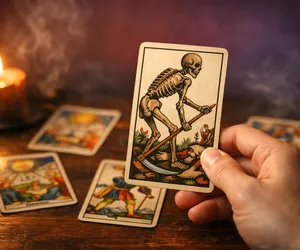
Let’s start with the undisputed champion. There is a detail worth knowing here, because it separates the two decks most people read. In the Tarot de Marseille, arcanum XIII is the only major card whose name banner is left blank — French readers call it the nameless arcanum, and that emptiness is not a printing mistake. In the Rider-Waite-Smith deck most English-speaking readers learn on, the same card is labelled plainly: Death. Same card, two editorial choices, and the blank one tells you something: what is ending does not have a name in advance.
What It Actually Says
Death does not predict a death. It describes an ending that has already happened and that you have not acknowledged yet. That nuance is everything: when it comes up, the thing has usually been over for months. The relationship is finished, the job no longer fits, the friendship has emptied out — you know it, and you keep going through the motions anyway. XIII is not a blade falling. It is a statement of fact.
On the question that worries everyone, let me be blunt: no, it does not announce a physical death, and no serious reader will ever read a death in a card. I have covered that question on its own, at length, in what the Death card really means in a reading — if that is your specific fear, go there, the full answer is waiting.
Why It Is the Most Useful Card in the Deck
Because it does not ask you to decide. It asks you to acknowledge, which is infinitely easier and infinitely more freeing. Look at the picture: the skeleton mows, but the ground is covered with hands, feet and heads growing back. In most decks one of those heads is wearing a crown. What the scythe takes is not the point; what grows back behind it is.
In practice, XIII brings energy. People dread it when they see it and almost always leave lighter, because it authorizes the thing they would not authorize themselves: stopping. It turns a hesitation that has dragged on into a decision that has been made.
Its Bright Side, and Its Warning
The bright side: it cleans house. It cuts off what has been dragging, and it frees up time, attention and sometimes money. After a Death card well travelled, people change their hair, their city or their career — and they talk about it years later as the turning point.
The warning: it says nothing about what comes next. That is its real limit, and it is a serious one. XIII closes a door without showing you another, and that empty stretch is genuinely uncomfortable. It does not negotiate either: what it points at cannot be half-saved. And symbolic grief hurts for real — leaving a ten-year project takes the same work as real heartbreak, and nobody is going to give you permission for it.
The move to make: write down, in one sentence, what is already over, and the date it ended. Not what you are going to do — that comes on its own. Just the fact, dated. Nine times out of ten the date is well before the reading, and that discovery is what unlocks everything.
One note for the curious: XIII is traditionally linked to Scorpio, the sign of endings and rebirths. If that symbolism speaks to you, the Scorpio profile and the yearly Scorpio horoscope dig into the same material from a different angle.
The Tower (XVI): The Collapse That Sets You Free 🗼
If Death is the most dreaded, The Tower is the most spectacular: a tower struck by fire from the sky, two figures falling head first. Hard to be more explicit than that.
What It Actually Says
It describes a structure giving way. Not your life: a structure. An arrangement, a jury-rigged balance, a situation that was still standing out of habit. XVI is brutal in its timing — it happens all at once, often from the outside, with no notice. But look at the picture again: the two figures are falling out of the tower. They were not better off inside.
Its Bright Side, and Its Warning
The bright side: it is fast. Where Death stretches a process out, The Tower settles in a week what had been rotting for three years. And it spares you the decision: nobody will blame you for failing to hold up a tower that lightning brought down. Most people tell me, six months later, that what they felt first was relief, before the sadness.
The warning: the shock is real, and it cannot be scheduled. It can hit concrete things — a home, a contract, a sum of money. And it has a trap all of its own: the urge to rebuild the exact same tower, in the same spot, with the same materials, the very next week. That is the classic mistake.
There is one variant worth knowing, because it changes the reading completely: The Tower can describe a collapse you caused. Handing in your notice, ending a marriage, shutting down a company — from the outside it looks like destruction, from the inside it was a decision. The card does not distinguish between the two, and that is the point: the effect on your life is the same either way, and so is the work that follows.
The move to make: wait three weeks before rebuilding anything. Get yourself safe, handle the practical side, and let the urge to restore everything as it was pass through you. What you build after that delay will look nothing like what you would have built in the heat of the moment.
The Devil (XV): The Chains Are Looser Than They Look ⛓️
The Devil frightens people for a different reason than the first two: they think it is about evil. It is about attachment.
What It Actually Says
Arcanum XV describes a bond that holds you more than it feeds you. A dependency, a fascination, a moral contract with yourself. It is not necessarily a dark story: it can be a thrilling job that eats everything, a magnetic relationship, a stubborn habit. The detail that decides the whole reading is in the picture: the two figures chained to the pedestal are wearing collars loose enough to slip off. They do not slip them off.
That is the entire card. It does not say “you are a prisoner,” it says “you are staying.” And if you are staying, there is a benefit somewhere — rarely one you would admit to, never a nonexistent one.
Its Bright Side, and Its Warning
The bright side: this is a card of raw energy, desire, vitality and creative drive. Turned your way, it gives you a formidable capacity for work. Plenty of creative people live with a Devil in their pocket and do perfectly well, as long as they know which one it is.
The warning: it makes you lucid, not free. Seeing the chain does not undo it, and XV has a talent for showing up two, three, five times in a row as long as nothing moves. Watch out for the accusatory reading too: The Devil points at a mechanism, not at a culprit. Aiming it at somebody else is the fastest way to miss what it is showing you.
One practical marker, because people ask: The Devil is not the card of addiction as a medical matter. It describes the shape of a bond, not a clinical condition, and no card will ever tell you whether you need help with one. If that is the real question, the answer is a professional, not a deck.
The move to make: finish the sentence “if I let this go, I would also lose…”. The answer is the real subject. Nobody stays attached for nothing; you stay for the thing you do not want to lose at the same time. That one sentence does more work than ten readings.
The Moon (XVIII): Fog Is Not a Lie 🌙
The Moon is the sneakiest of the five. It does not strike: it unsettles. Two towers, two howling dogs, a crayfish in dark water, and no human figure anywhere to guide you.
What It Actually Says
It describes a moment when you cannot see clearly. That is all — and that is already a lot. Be careful with the widespread reading that turns it into a card of betrayal: XVIII does not say you are being lied to, it says you do not have all the pieces. Those two situations feel identical from the inside and call for completely different behaviour. In one case you investigate; in the other, you wait.
The Moon is also the card of imagination, dreams, night-time intuition and everything that surfaces unannounced. Part of that fog is coming from you, from your projections and your old fears. That is not a flaw: it is information about your state, not about the world.
Its Bright Side, and Its Warning
The bright side: it protects you by stopping you from deciding too fast. When it lands on a decision, it almost always says “not now, not with this information.” Followed to the letter, that advice prevents a lot of expensive mistakes.
The warning: it is exhausting. Uncertainty wears people down more than bad news does, and the temptation is to fill the gap with hypotheses. That is exactly what you must not do. XVIII is walked through; it is not solved by thinking harder.
The move to make: write down what you know and what you are assuming, in two columns. It takes five minutes and the result is often brutal: the facts column is tiny. As long as it stays tiny, no decision will hold. Ask again in two weeks, with a sharper question — our guide to choosing the right spread for your question explains how to frame one.
The Hanged Man (XII): The Wait Mistaken for a Punishment 🙃
A man suspended by one foot, upside down, hands behind his back. The Hanged Man worries people less than it irritates them: it announces that nothing is moving just yet.
What It Actually Says
Arcanum XII describes a suspension, chosen or imposed, during which something is quietly at work. Look closely at the image: the figure shows no sign of suffering, his hair is neat and his face is calm. More to the point, the rope is tied at his ankle — in theory, he could untie himself. He is choosing the upside-down view.
In practice: a file that will not move, an answer that will not come, a stretch where everyone seems to be progressing except you. The Hanged Man does not say you have failed. It says the calendar is not yours on this one.
Its Bright Side, and Its Warning
The bright side: this is the card of the shifted perspective. People who travel a Hanged Man well see their situation differently by the end, and that new reading is often worth more than the outcome they were waiting for.
The warning: it does not say how long. No card gives you a duration, and this one least of all. Its trap is pointless sacrifice: waiting for the sake of waiting, going without in the belief that the deprivation itself will produce the result. It will not.
Worth adding: XII is the only one of the five that says nothing at all about the outcome. Death names an ending, The Tower names a collapse, The Devil names a bond, The Moon names a fog. The Hanged Man names a delay and stops there. That is why it frustrates people so much — and also why it is the least dangerous card of the five to draw.
The move to make: separate what depends on you from what does not, and act only on the first list. Everything else is wasted fuel. This is the card that teaches that economy best.
The Four Gentle Cards Nobody Is Wary Of 🍯
Here is the part that articles about “negative tarot cards” always forget: in an actual reading, the hard cards are not the problem. Their opposites are. Four beautiful cards lull people to sleep, precisely because nobody thinks to be careful with them.
Temperance (XIIII): Comfort as Anaesthetic
Temperance pours liquid from one vessel into another, endlessly. Balance, circulation, gentleness — lovely. Except that in a situation calling for a clean break, this card describes someone who has been smoothing things over for years and calling it wisdom. Permanent blending sometimes prevents choosing.
The Star (XVII): Passive Waiting
The Star is the most beautiful card in the deck and the most misused. Hope, protection, confidence returning: yes. But I have watched it justify “it will happen on its own eventually” more times than I can count. The woman on the card is pouring her jugs into the river. She is doing something. She is not contemplating.
The Sun (XVIIII): Success That Hides Things
The Sun lights everything up, including what you would rather keep in shadow — and it dazzles. A visibly happy period can perfectly well be sitting on top of a deep problem nobody dares raise, precisely because everything is going well. This is the card of the beautiful shop window.
The Magician (I): The Eternal First Day
The Magician has every tool on the table and all the energy of a beginning. Wonderful when you are starting out. Much less so when it shows up for the fourth time on the same project: then it describes someone who keeps starting and never finishes. Its cousin The Fool asks the same question about movement, without the safety net.
The rule I draw from this: a card is neither good nor bad, it is suited or unsuited to what you are living. Death on a rotten situation is excellent news. The Star on an emergency is bad news. Context makes the card — which is exactly what the next section is about.
The Same Card Says Different Things Depending on Where It Lands 🔀
A card is never read alone. Its position in the spread changes its meaning as much as its drawing does. Here is XIII, the most dreaded of them, speaking according to where it falls — the same reasoning applies to the other four.
| Position in the spread | What Death is saying there |
| The past | A page already turned: it explains where you come from, it announces nothing |
| The present | You are in it, right in the middle: time to acknowledge, not to resist |
| The near future | An ending you can already sense coming: you have time to prepare for it |
| The advice | An order to clear house: cut what is dragging, the card gives you permission |
| The obstacle | It is your refusal to finish that is blocking things, not the situation |
| The people around you | Someone close is going through an upheaval and you are catching the backwash |
Same card, six messages, two of which call for no action whatsoever. This is why a single-card draw is so hard to interpret: with no position, the card has no address. If you practise the one-card spread, the question you ask plays the role of the position — which is why phrasing it properly matters so much. Larger layouts such as the cross spread give each card its address by design.
What About Reversed Cards?
In the traditional Tarot de Marseille, reversals are not compulsory, and plenty of readers — myself included — do not use them systematically. When they are used, a reversed card is not “the opposite” or “worse”: it points to an energy that is blocked, turned inward or badly spent. A reversed Death typically describes somebody clinging on; that is not darker than the upright version, it is more uncomfortable. The card-by-card meanings guide places that difference between schools in context.
The Three-Card Protocol for When a Card Scares You 🕯️
Here is what I do when a hard card lands and the person in front of me shuts down. Four steps, ten minutes, and it works just as well alone at your kitchen table.
1. Describe the Image Before Interpreting It
Out loud, as if you were describing a painting to someone who cannot see it. “A skeleton, a scythe, hands coming out of the ground, black and red.” This step sounds silly and it is the most important one. It moves you from reacting to observing, and it very often surfaces a detail the fear had hidden.
2. Draw Two Framing Cards
One on the left: what is ending. One on the right: what is beginning. Ask nothing else. Those two cards bracket the frightening one and give it back its real size — almost always smaller than the fright it caused.
3. Read the Line, Never the Single Card
Three cards make a sentence. A card on its own is just a word, and a word means nothing out of context. If you take one thing away from this whole article, take that one. The other ways of assembling cards are reviewed in our overview of tarot spreads, from one card to twelve.
4. Write It Down, Date It, Close the Deck
Three lines in a notebook: the date, the cards, what you understood. Then put the deck away. Do not draw on the same question tomorrow: it is the most common reflex and the most counterproductive one. Rereading those notes three months later is worth every interpretation — you will often find that the dreaded card described exactly what happened, in a far less dramatic way.
Your Questions About the Scariest Tarot Cards ❓
The questions that come up most often in readings, with short answers.
What Is the Most Feared Card in Tarot?
Death, arcanum XIII, with no competition. It owes its reputation to its imagery and to the movies, not to its meaning: it describes an ending already under way, never a physical death. The Tower comes a close second, and in practice it is often the more brutal of the two.
Are There Really Negative Tarot Cards?
No. A card is suited or unsuited to what you are going through. Death on a situation that will not end is excellent news; The Star, famously lovely, is bad news on an emergency that needed a decision. Context makes the card, not the drawing on it.
Why Does the Death Card Have No Name in Some Decks?
In the Tarot de Marseille the name banner at the bottom of arcanum XIII is left blank, which is why French readers call it the nameless arcanum. Tradition reads that as a way of not locking the card into a single word — what ends does not go by the same name for everyone. Rider-Waite-Smith decks, by contrast, label it outright.
Is a Reversed Card More Negative?
Not more negative: differently oriented. A reversed card signals an energy that is blocked, held back or badly spent, not an extra helping of misfortune. Many readers in the Marseille tradition do not use reversals at all and read everything upright.
I Keep Drawing the Same Scary Card. Does That Mean Something?
Mostly it means the question has not moved. A card that keeps coming back repeats its message because nothing was acted on between readings. Rather than drawing again, change the angle: ask what is stopping you from acting, instead of what is going to happen.
Can Tarot Bring Bad Luck?
No. A deck of cards has no power over events; it is a medium for symbolic reading. What can do harm is a categorical interpretation — an announced date, a diagnosis, a sense of doom. A good reading always leaves the decision in your hands.
What These Cards Do Not Say 🚫
Let’s be clear about the limits, because they are the best antidote to fear there is.
They Do Not Give Dates
No card carries a calendar. Timing correspondences exist, they vary from school to school, and they are never a commitment. Anyone who announces an event to the day from a card is making it up.
They Do Not Diagnose Anything
Not medically, not legally, not financially. Tarot is a tool for personal insight, not an expert opinion, and it replaces neither a doctor, nor a lawyer, nor an adviser. If a reader announces an illness or a death from a card, the problem is not the card: it is the reader.
They Do Not Decide for You
A reading describes tendencies and possibilities at a given moment. It locks nothing in. I have watched people turn a Tower into a chosen move and others take it full in the face: same card, two stories, because what you do with the information matters more than the information.
A Dreaded Card Is Only a Door Left Ajar ✨
If you keep one idea: scary tarot cards are the ones talking to you about the places where something has to move. That is uncomfortable, not threatening. Death states an ending, The Tower brings down a tired structure, The Devil shows you a chain you are holding yourself, The Moon asks you to wait for daylight, The Hanged Man teaches you to stop forcing. None of them condemns you; all of them inform you.
A reading is a photograph, not a verdict. The future is never entirely fixed, and a card that chills you today may well be the one you point to in two years as the moment things tipped the right way. You remain in charge of your own path: the cards light the road, they do not drive the car.
And if you feel like drawing — just to see — start with a question you actually want the answer to. The rest follows. Online tarot and the free love tarot are good practice grounds before you take on the questions that matter.
Editor’s note: a hard card is not a sentenceIf a card chilled you, do not close the deck on that impression. Describe the image, draw the two framing cards, and read the whole line. Nine times out of ten, the full sentence is far less frightening than the isolated word.
And if you have been circling the same card for weeks, having it read by someone who does this every day will save you months of going round in circles. |
Did this clear something up? Send it to the person in your life who refuses to draw a card “just in case.”
Read next:







Did you like this article?
Want to know more 🤔 ?
Write directly to the authorAvaOf Light !
Ask Ava a question