Card XIII: the card the Tarot of Marseille refuses to name 🂭
Here's a detail most people miss: in the traditional Tarot of Marseille, card 13 carries no title at all. Every other card spells its name across the bottom banner, LE BATELEUR, LA PAPESSE, LE DIABLE, but this one has only its number. Hence its nickname in French decks: the Nameless Arcanum.
The most widely repeated explanation is superstition: people avoided writing the word so as not to invite the thing. It's a seductive story and it circulates everywhere. Let's be honest, though: historians of playing cards are more cautious, and point to far more mundane causes, such as workshop conventions and the standardisation of woodblocks. We won't settle that here.
What matters, for anyone reading cards, is what the absence produces. A card without a name is a card you can't file away. It forces you to look at the image instead of reciting a label, and believe me, that's an excellent school. You find the same deliberate gap in the Fool, who has a name but no number: two cards slipping out of the system, each in its own way.
What is the Death card image actually telling you? 🐎
Take the best-known version in the world, the Rider-Waite-Smith deck drawn in 1909. Arthur Edward Waite described it himself in his Pictorial Key to the Tarot, and the description is genuinely surprising when you read it without preconceptions.
- 🐎 The rider moves slowly, in black armour, on a white horse. He isn't charging, he isn't striking. He's crossing through.
- 🌹 He carries no visible weapon, no scythe, but a black banner bearing a five-petalled Mystic Rose which, Waite writes, signifies life. It is the only living, blooming thing on the whole card.
- 🌅 On the horizon, between two pillars, a sun is rising. Not setting. Rising.
- 👑 A king, a child and a maiden fall before him, while a bishop, hands clasped, stands and awaits him.
Waite explicitly refused to reduce the card to "the crude notion of the reaping skeleton." For him it speaks of the veil of life perpetuated in change, of passage from a lower state to a higher one. The Tarot of Marseille does keep its skeleton and its scythe, and that scythe harvests heads and hands which, in most versions, are already sprouting back out of the soil. Two images, one message: it goes on.
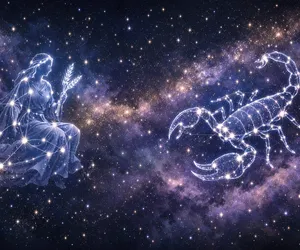
Scorpio and the letter Nun: the correspondences of card XIII ♏
Since the late nineteenth century and the work of the Golden Dawn, card XIII has been tied to Scorpio in astrology and to the Hebrew letter Nun, whose name means "fish." On the Tree of Life the card sits on the twenty-fourth path, between Tiphareth and Netzach.
You don't need any of that to read your cards. But the Scorpio link does illuminate the card: a fixed water sign ruled by Mars and Pluto, Scorpio is the zodiac's specialist in shedding, deep dives and rebirths. Its totem animal is the snake, symbol of rebirth, which changes skin without dying. That is card XIII's entire programme: you leave a skin behind, not a life.
What the Death card actually points to in a reading 🔁
Let's get concrete. When card XIII shows up, it nearly always marks a place in your life where something has already begun to end, often before you've admitted it. Here's how that plays out by area of the question.
| Area | What the Death card is saying | The question worth asking |
| Love 💞 | A page turns: the end of a relationship, or the end of a way of being in one. | What am I keeping alive purely out of habit? |
| Work 💼 | A job, a trade or a role has run its course. Career change, departure, shift in scope. | How long have I been bored without saying it? |
| Money 💶 | A financial setup that no longer holds. End of a lifestyle, back to the drawing board. | What am I still paying for that no longer serves me? |
| Inner life 🌱 | A belief, a loyalty or a self-image falling away. This is the most frequent reading of all. | Who was I when I decided that? |
Notice what these have in common? None of them is something you simply endure from start to finish. The card announces the movement, not the verdict. And depending on its neighbours, the same Death card can describe a liberating move across the country or a slow inner grief. The surrounding cards give it its colour, never the card alone.
Death card combinations: 5 pairings that change everything 🔗
Since everything hangs on the neighbours, here are the combinations I meet most often and what they say. They work in a three-card spread as well as in a cross.
- 🗼 Death + the Tower: the ending won't be gentle or gradual: it arrives through an outside event that forces your hand. The advice never changes: don't spend your energy holding up the structure that's falling; take care of the people inside it.
- ⭐ Death + the Star: my favourite pairing. A clean ending followed by real relief: what you're leaving won't be missed as much as you fear. This is the classic combination for breakups nobody regrets.
- 🌙 Death + the Moon: the ending is here but nobody has said it out loud. Unspoken things, blurry situations, someone not owning their decision. The real question isn't "is it over?" but "why is no one naming it?"
- ☀️ Death + the Sun: the shedding is largely done, and it suits you. This pair turns up constantly for people mid-career-change who are still second-guessing themselves. Spoiler: the cards aren't second-guessing.
- 🕰️ Death + the Hanged Man: the transformation is under way but taking forever, and that slowness is not a punishment. This is the combination of dormant periods, the ones where you feel stuck while everything reorganises underneath.
Keep the principle rather than the list: Death supplies the movement, the neighbouring card supplies the weather. It's also why choosing the right tarot spread always beats yanking one card out in a panic.
So what about the "almost"? The rare times Death does speak of grief 🕯️
I wrote "almost never," not "never." I'd rather be straight about this, because articles promising the card is always cheerful bother me as much as the ones designed to frighten.
Card XIII does sometimes appear while someone is genuinely grieving. But mind the order of events: in those readings, the loss has already happened. The card doesn't announce it, it acknowledges it. It names a sorrow that is already in the room, and asks the next question: what do we do with what's left?
It can also point to a very concrete symbolic death: the end of a twenty-year friendship, a divorce, a child leaving home, a body that's changing. Those endings genuinely hurt. Reducing them to a tidy "renewal" would be dishonest.
What I can state plainly, though: no card of any kind gives a medical prognosis. Nobody should walk out of a reading with a date in their head. If a practitioner announces a death to you on the strength of one card, you're in the wrong room, and tarot isn't what's at fault.
The Death card reversed: what does it mean? 🔄
Reversed, card XIII changes register without changing subject. Where the upright card shows transformation in motion, the reversed one describes a transformation that's stuck.
In practice: staying in a relationship that ended two years ago, keeping a job you no longer like out of comfort, replaying a script you know by heart while hoping for a different last act. It's the "I know, but not yet" card. It isn't graver than the upright version, just more tiring, because it describes energy pushing against a lid.
The advice that goes with it never varies: find the smallest thing you can genuinely finish this week. Not the big decision, the small one. Clear out a drawer, send the message you keep postponing, say no once. Card XIII loosens through action, not through thinking.
3 things to do when the Death card lands in your spread ✅
Just turned it over and reading this with the cards still laid out in front of you? Here's what I do, in this order.
- 🫁 Breathe before you interpret. The first reading that surfaces is almost always dictated by fear, not by the card. Let thirty seconds pass, look at the image again, and write down what you see rather than what you dread.
- 👀 Look at the neighbours. A card is never read alone: go back through the five combinations above before you conclude anything at all.
- ✍️ Turn the card into a question, not a verdict. "What has already ended in this story?" will always give you more than "what's going to happen to me?" Tarot is better at lighting things up than at prophecy.
Want to test all this yourself? A free tarot draw is still the easiest way to get familiar with the Major Arcana with nothing at stake.
The 3 most common misreadings ⚠️
After years of receiving people who arrive panicked by this card, I keep seeing the same shortcuts.
- 🚫 Reading the card literally. Tarot works through symbols, not documentary illustrations. Nobody interprets the Lovers as "you're getting married on Thursday," so there's no reason to treat Death differently. The meanings of the Tarot of Marseille cards are all built that way.
- 🔁 Re-drawing until it disappears. The most human reflex there is, and the most useless. Pulling ten more times doesn't change the message, it just muddies the reading.
- 🎯 Forgetting its position in the spread. Death in the "past" slot says something completely different from Death in the "outcome" slot. In the past position it usually describes a rupture you've already digested, which explains the rest of the reading. If you want a straight binary answer instead, the yes or no tarot is built for that, and this card is not.
One last story. My grandmother, who passed all of this down to me, had a stock reply whenever a client went pale in front of card XIII. She'd say: "It came out because you already knew." Nine times out of ten the person ended up nodding. It's still the most accurate definition of this card I know.
❓ The Death tarot card: your questions answered
Does the Death card predict an actual death?
No, not in the vast majority of readings. Card XIII describes the end of a cycle and a transformation, not a physical death. A tarot reader has neither the calling nor the standing to announce a death, so if that has happened to you, find another practitioner.
Why does card 13 of the Tarot of Marseille have no name?
It's the only card in the deck without a title. The most common explanation invokes superstition around the word "death," but historians of playing cards stay cautious and also point to workshop conventions. In practice, that missing name mostly invites you to look at the image rather than at a label.
What does the Death card mean in love?
It most often signals the end of a way of loving rather than the end of the story: a couple dynamic that has run its course, a dependency unravelling, a role you're stepping out of. Surrounded by favourable cards like the Star or the Sun, it frequently describes a fresh start together.
Is the reversed Death card more negative?
No, mostly more static. Reversed, it flags a transformation that's blocked: you know a chapter is finished, but you aren't closing it. The remedy is always one small concrete gesture, never a grand decision.
Which zodiac sign matches the Death card?
Scorpio, according to the correspondences established in the late nineteenth century by the Golden Dawn, along with the Hebrew letter Nun. A water sign ruled by Mars and Pluto, Scorpio shares card XIII's taste for deep sheddings and rebirths.
In the end, you decide what has to finish ✨
If you take away one thing: the Death tarot card is not announcing a death, it's showing you a place where life has already started moving without asking your permission. The rest, what you do with it, how fast, with what support, belongs entirely to you.
The cards show trends and possibilities, never a fate carved in stone. The future is never fully fixed: it gets built out of your choices, your renunciations and your nerve. Card XIII is probably the least loved card in the deck, and yet one of the most generous. It tells you there is still something afterwards. What that something is, is yours to decide. If you like planning ahead, your yearly tarot predictions pick up exactly where this card leaves off.
The editor's word: what's ending has already left youThis week, don't go looking for the big decision. Spot one tiny thing you've known was over for ages, and finish it for good. That's exactly the work card XIII is asking for, and it needs no cards at all to be done.
Did this card land on a question that really matters to you, and you'd like to talk it through with someone who reads cards every day? A reader will help you put it back in context, which no article can do for you. |
Know someone who refuses to have their cards read "just in case" this one turns up? Send them this article. They'll sleep better tonight. 🃏
Further reading 📚






Did you like this article?
Want to know more 🤔 ?
Write directly to the authorAvaOf Light !
Ask Ava a question