The Hermit's 6 Attributes for December
Before we get into the details, here's the card broken down into six attributes. Each one carries a message for the end of the year and a two-word piece of advice. Find the one that speaks to you most: that's probably where the Hermit wants to take you this month.
The 6 Attributes at a Glance
This summary is here to help you find your way afterward: each line takes you to its attribute.
The attribute
What it says for December
The advice in two words
= Light only the next step
The advice:
One step
⇣
= Go slowly, but keep going
The advice:
Slow down
⇣
= Shield your light from the noise
The advice:
Protect yourself
⇣
= Withdraw to see more clearly
The advice:
Step back
⇣
= Be alone without being isolated
The advice:
Choose it
⇣
= Share what you've understood
The advice:
Pass it on
⇣
The Hermit's Lantern: Light the Next Step, Not the Whole Road 🏮
Attribute 1 · One step
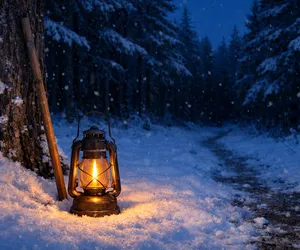
It's the object everyone remembers, and it's the heart of the card. The Hermit's lantern isn't a floodlight. It doesn't turn night into day. It gives just enough light to see where to put your next foot. On the card it's partly hidden by the cloak, and many tarot readers see it as an inner light: a clarity you carry inside rather than shine on other people.
Back when I was an engineer, we had a rule for projects that were going off in every direction: stop planning the whole year and look only at the next step you can actually check. That's exactly what the lantern suggests. In December we tend to want to wrap everything up, understand everything and decide everything before the 31st. The Hermit calmly tells you that you don't need to see the whole road through 2027. You need to see the six feet in front of you.
It says something else too: the light you're looking for outside, you already have. The answers to “What do I really want next year?” won't come from other people's year-in-review posts or the resolution lists you see everywhere. They come from what you already sense intuitively, and what the noise of December drowns out.
The bright side
The lantern brings clarity without demanding certainty. It lets you move forward without a complete plan, and that's often what gets a situation moving after months of being stuck.
Your December step
Pick one single decision to shed light on before the end of December, and let the others wait until January.
The warning
A light kept too well hidden stops being useful. If you already know what needs to change but refuse to look at it, the veiled lantern becomes an excuse to stay in the fog.
📌 Three questions to ask yourself
- What's the next step I can see clearly, even if I can't see what comes after?
- What small light inside me have I set aside this year?
- What do I already know, deep down, but pretend not to know?
The Staff: Go Slowly, but Keep Going 🪵
Attribute 2 · Slow down
The Hermit doesn't float above the ground. He walks, and he leans on something. His staff tests the ground before his foot lands: it's the tool of someone who knows the path is uneven and would rather check than rush. American tarot author Eden Gray saw it as the patriarch's staff that helps him through narrow paths. It isn't a crutch; it's a support he has chosen.
In a reading, the staff is about pace. Our card page says it plainly: the Hermit signals that things need more time to develop. For December, that's almost a permission slip. You aren't behind because you haven't wrapped everything up. You're moving at the speed the season sets, the speed of the longest nights of the year.
The staff is also what keeps you upright when you get tired. A habit, a person, an evening routine, a place where you feel safe. The Hermit doesn't walk without support, and he doesn't ask you to either.
The bright side
Slowness becomes a method. You move less quickly, but you fall less often, and projects get to mature instead of being rushed.
Your December step
Take one commitment out of your December schedule that isn't moving you forward, and save your energy for the one that matters.
The warning
Slow can slide into stuck. Badly placed in a reading, the Hermit points to a slowdown that's settling in. Make sure you're still walking, even in small steps.
📌 Three questions to ask yourself
- What do I really lean on when I'm worn out?
- Which project did I try to force this year when it actually needed time to mature?
- What pace could I realistically keep up in January without burning out?
The Cloak: Shield Your Light From the Year-End Noise 🧥
Attribute 3 · Protect yourself
People tend to forget it, but the cloak takes up half the card. It's long and heavy and has a hood: a traveler's garment, made for night and cold. It hides the body, partly veils the lantern and shields the flame from the wind. Eden Gray read it as a form of discretion. You don't put yourself on display while you're doing inner work.
It may be the most useful attribute for December. The holidays have a knack for putting us in the shop window: we tell the story of our year, we compare, we answer “So, what's new with you?” a dozen times in two weeks. The Hermit's cloak gives you permission not to tell everything. A project that's still fragile, a decision that's still forming, a hurt you haven't processed yet: all of that can stay under the cloak for as long as it needs to.
Shielding your light isn't hiding. It's choosing who gets to see it, and when. A flame exposed to the wind the moment it's lit has little chance of lasting until spring.
The bright side
The cloak creates a private space in the middle of all the bustle. It lets you keep your ideas warm until they're solid enough to share.
Your December step
Keep the most fragile project you're carrying to yourself until January, and share it with just one person you trust.
The warning
Too much cloak and you become hard to read. If you close yourself off so much that the people close to you no longer know how to reach you, protection turns into a wall.
📌 Three questions to ask yourself
- What don't I feel like talking about over the holidays, and am I allowed to keep it to myself?
- Who in my life deserves to see my light before anyone else?
- Am I protecting myself, or shutting myself away?
The Step Aside: Withdraw to See More Clearly 🌲
Attribute 4 · Step back
The Hermit is the one who has left the crowd. Not out of resentment, and not to run away: to get some distance. Our card page puts it nicely: he reminds us that sometimes it's good to pause and withdraw from the world in order to understand ourselves better and prepare for the future. He prepares what's ahead with independence, it adds, and calls for wisdom in the most delicate situations.
In December, that step aside can be very concrete. An evening with no screens before the holidays. An hour alone on the morning of January 1st. A walk without your phone. You don't need a monastery. You need a place where nobody asks anything of you for a while, so you can look at your year from the outside.
At work, our card page links the Hermit to research, study and letting projects mature. The step aside is the ideal moment to review what you've achieved without judging yourself, the way you'd read through someone else's file. You often see the road you've traveled more clearly once you're no longer on it.
The bright side
Distance gives you the big picture. What looked like a failure up close becomes a stage, and what seemed urgent loses its grip.
Your December step
Right now, block out two hours just for yourself between December 20 and December 31, and keep them like an appointment.
The warning
A step aside that lasts too long turns into an absence. Our card page mentions an excessive withdrawal, where you curl up into yourself and cut yourself off from the world. Retreat is a pause, not a new address.
📌 Three questions to ask yourself
- If I looked at my year as if it were a friend's, what would I tell them?
- What do I need to step away from a little in order to see clearly?
- When in December could I actually have some peace and quiet?
Chosen Solitude: Alone Without Being Isolated 🕯️
Attribute 5 · Choose it
It's the phrase our card page uses in its very first lines: the Hermit embodies chosen solitude. The key word is “chosen.” There's the solitude you endure, the kind that weighs on you over the holidays when you feel left out, and the solitude you give yourself, the kind that recharges you. The Hermit is talking about the second one.
For many of us, December is the month when we're least alone and most exhausted. One dinner follows another, we try to please everyone, we're always available. Choosing a moment of solitude isn't rejecting other people. It's making sure you'll still have something to give them. My own approach is to book those moments in advance, like any other appointment, because otherwise the month swallows them all.
In love, our card page reads the Hermit as an invitation to understand your feelings and wishes before you commit. That holds whether you're in a relationship or single: a little quiet helps you tell what you truly want from what you think you should want because it's the season.
The bright side
Chosen solitude puts your thoughts in order and makes you more present afterward. You come back to people calmer, clearer and less defensive.
Your December step
Set aside one hour of solitude each week in December, and tell the people close to you that it's a choice, not a sulk.
The warning
If solitude is no longer a choice, if it feels heavy, if it comes with a sadness that won't lift, the Hermit is no longer the right guide. This isn't the time to withdraw further. It's the time to reach out.
📌 Three questions to ask yourself
- When was I alone this year, and did I choose it?
- What truly recharges me, and what drains me?
- Who do I want to spend the holidays with, and who am I forcing myself to see?
Passing It On: What the Wise Do With What They've Learned 📜
Attribute 6 · Pass it on
It's easy to forget, but the Hermit isn't just a man who withdraws. He walks with a lit lantern, which means people can see him from far away. The earliest Italian sources simply called him “the Old Man,” and that's what we see on the card: an elder. In every family, the elder isn't the one who keeps what they know to themselves. They're the one people turn to.
At the end of the year, that idea is precious. What you've learned in 2026, through your mistakes as much as your successes, could help someone else. Advice for a colleague who's just starting out, a family recipe handed down, a story told to a child, a letter to someone going through what you've already been through. The holidays are often the only time of year when several generations sit at the same table. It's the moment to ask the older ones what they've learned, and to tell the younger ones what you have.
Passing something on is also the gentlest way to close a year. What's been passed on isn't lost, and what isn't lost can finally be set down.
The bright side
Passing it on gives meaning to what you've been through. A hard time that helps someone else weighs less.
Your December step
Pick one thing you learned this year and pass it on to one specific person before December 31.
The warning
Passing it on isn't lecturing. The Hermit lights the way; he doesn't drag anyone along. Share when you're asked, or when you sense it's welcome.
📌 Three questions to ask yourself
- What did 2026 teach me that I didn't know back in January?
- Who could this lesson help?
- What question would I like to ask an older member of my family over the holidays?
✦







Did you like this article?
Want to know more 🤔 ?
Write directly to the authorAvaOf Light !
Ask Ava a question