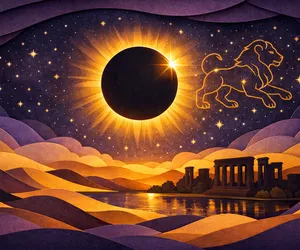
On Monday, August 2, 2027, the Moon will completely block the Sun for 6 minutes and 23 seconds near Luxor, Egypt. In the US, the sky won't go dark at all: the eclipse can't be seen from anywhere in the country.
Astrologically, you don't need a front-row seat. Here's what's at stake in Leo, and what it will stir up in your life, sign by sign 😏
The August 2 Eclipse at a Glance
When
08/02/2027, New Moon at 6:05 a.m. ET
Where in the sky
♌ At 10° Leo, close to the South Node
Where it's total
Southern Spain, North Africa, Egypt, Arabia
Its family
Saros 136, the same as the record eclipse of 2009
Signs most affected
Leo, Taurus, Scorpio, Aquarius
✦
Why Is It Called “the Eclipse of the Century”?
Totality often lasts two or three minutes. This one offers more than double that. The reason is simple: that day, the Moon has just passed its closest point to Earth, a few hours before the eclipse. It looks bigger, so it covers the Sun for longer.
The path of totality starts over the Atlantic, crosses the Strait of Gibraltar, sweeps across North Africa, then heads on to Arabia and Somalia. Night lasts longest just southeast of Luxor. No eclipse will last this long over easily accessible land until June 3, 2114.
Can You See It From the US?
No. The Moon's shadow sweeps across the other side of the Atlantic, from southern Spain to the Horn of Africa, and no part of the United States sees even a partial eclipse. To experience night in broad daylight, you'd have to travel to Cádiz or Málaga in Spain, Tangier in Morocco, or Luxor in Egypt. The good news: the next eclipse in this same family, on August 12, 2045, will cross the US from coast to coast.
⚠ Protect your eyes
If you travel to see it, remember that even a mostly covered Sun burns the retina, painlessly and without warning. Only look at it through eclipse glasses that meet the ISO 12312-2 standard: sunglasses, however dark, offer no protection.
✦
What the Eclipse Means in Astrology
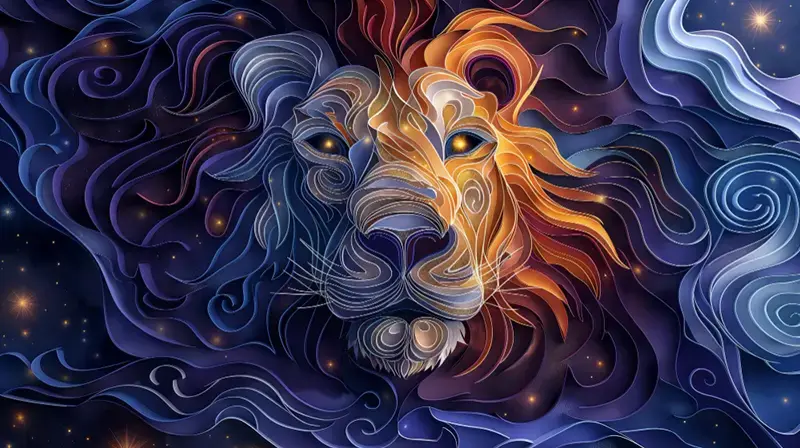
A solar eclipse is a New Moon times ten: it opens a new chapter, often without warning. This one forms at 10° Leo, the sign of the heart, of pride and of the urge to shine. It also falls close to the Moon's South Node, which stands for the past and old habits. Since summer 2026, the lunar nodes have been on the Leo-Aquarius axis: Leo is “me,” Aquarius is “us.” The message is twofold: you drop an old role, the one you played to be loved, and you dare to show up as who you really are.
“What goes dark on August 2 isn't the Sun. It's the character you've been playing out of habit.”
Good news: the sky that day is rather kind. Venus travels with the eclipse, and three planets send it harmonious aspects. Only Pluto, opposite, pulls the other way: it asks you to let go of control. An eclipse near the South Node is more about letting go than starting from scratch, anyway. That's why I read it as a fresh start for the heart that begins with a goodbye, rather than as an ordeal.
The Dates Surrounding the Eclipse
An eclipse doesn't stop on the day itself: its effects unfold over several weeks. Here are the key dates of the summer, in Eastern Time.
07/26Jupiter enters Virgo: time to get organized
07/29Sun opposite Pluto: a power struggle comes to light
08/02Total solar eclipse in Leo (6:05 a.m.): a chapter of the heart opens
08/11Sun conjunct Venus in Leo: charm at its peak
08/17Penumbral lunar eclipse in Aquarius (3:28 a.m.): a decision of the heart ripens
08/25Venus meets Jupiter in Virgo: the moment to ask
✦





 Aries
 Taurus
 Gemini
 Cancer
 Leo
 Virgo
 Libra
 Scorpio
 Sagittarius
 Capricorn
 Aquarius
 Pisces




Did you like this article?
Want to know more 🤔 ?
Write directly to the authorSusanTaylor !
Ask Susan a question