Living Winter With the Seasons: 4 Steps to Begin the Year Differently 🌿
Over my years of practice, I've seen so many people reach the end of January exhausted, convinced they had already “failed” their year. I'd like to suggest something else: not a starting line on January 1, but four steps, in tune with what nature actually does from December to March.
1. December-January: A Time for Rest, Not Performance 🌙
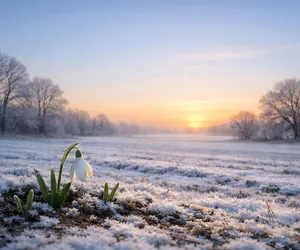
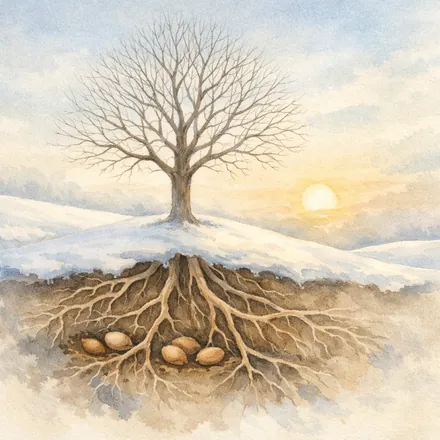
Look outside: nothing is growing. The trees are bare, the fields are sleeping. It isn't emptiness, it's preparation. Many seeds of trees, shrubs and perennials actually need this cold, moist spell to germinate: without a real winter, they won't sprout in spring. Gardeners call it stratification, and some recreate it in the fridge to “trick” the seed into believing it has been through winter.
I find this image so true for us. Demanding a brand-new burst of energy from yourself on January 2, in the heart of the darkest season, is like asking a seed to sprout in the snow. If January finds you tired, with no appetite for big projects, that isn't failure: it's the season. Sleep more, simplify your evenings, leave some blank spaces in your calendar. Winter rest isn't wasted time: it's when the roots do their work.
One caveat, though: if this dip in energy turns into a sadness that lingers, weighing on your sleep or appetite, talk to your doctor. The rhythm of the seasons can support you, but it doesn't replace care.
Seed stratification: Wikipedia “Stratification (seeds)” · Piedmont Master Gardeners, “Seed Stratification: Why Does Temperature Make a Difference?”
2. The Winter Solstice: The Light Returns Before the Renewal ☀️
Winter's true turning point doesn't fall on January 1, but ten days earlier. In 2026, the winter solstice arrives on Monday, December 21, at 3:50 p.m. Eastern time: it's the longest night of the year, and from the next day on, the days get longer. The Anglo-Saxons called December and January Giuli, after the day the Sun “turns back,” as the monk Bede recorded around 725. It's the festival of Yule, the winter solstice.
What I love about this moment is that it asks nothing of you. The light comes back on its own, without anyone pushing it. Just notice it on the morning of December 22: the day has started to grow. Let the rest of winter grow quietly, and you along with it.
Solstice of 12/21/2026 at 20:50 UTC: Wikipedia “Solstice,” Farmers' Almanac · Giuli: Bede, De temporum ratione, cited by Wikipedia “Yule”
3. Imbolc, February 1: A Time to Plant 🌱
Six weeks later, halfway between the solstice and the equinox, the Gaelic calendar celebrates Imbolc on February 1. In Ireland, it's still the first day of spring and the feast of Saint Brigid, a public holiday since 2023. According to the most common, though debated, etymology, the word comes from Old Irish for “in the belly,” for the pregnant ewes of this time of year: life is there, but you can't see it yet.
To me, this is the right moment to choose what you want to grow this year. Not everything. One or two things you've had time to ripen during January's rest. You don't plant in frozen ground, you plant when the soil starts to warm: your decisions also gain from waiting for that moment.
Imbolc, February 1, Saint Brigid: Wikipedia “Imbolc,” myireland.ie (public holiday since 2023) · etymology: Wikipedia, Wiktionary “Imbolc”
4. The Spring Equinox: The Real Fresh Start 🌸
On Saturday, March 20, 2027, in the late afternoon (Eastern time), day and night are in balance: it's the spring equinox. That's when nature finally gets going. And it isn't a poet's whim: the oldest Roman calendar opened the year in March, and to this day Nowruz, the Persian New Year, begins on the day of the equinox. This spring festival is inscribed on UNESCO's list of intangible cultural heritage and is celebrated from Iran to Central Asia and Turkey. On the Wheel of the Year, this moment is called Ostara, the spring equinox.
That's when I invite you to take action: launch the project, start the new habit, make the decision you planted at Imbolc. You'll have the light, the rising energy of the season, and a whole winter behind you to prepare. Nothing stops you from starting sooner, of course. But if nothing has taken off by January 15, you haven't missed a thing: the season of new beginnings hasn't started yet.
Equinox of 3/20/2027 (20:24-20:25 UTC depending on the source): timeanddate.com, EarthSky · Nowruz: Wikipedia “Nowruz,” UNESCO
✦











Did you like this article?
Want to know more 🤔 ?
Write directly to the authorMadisonCarter !
Ask Madison a question