
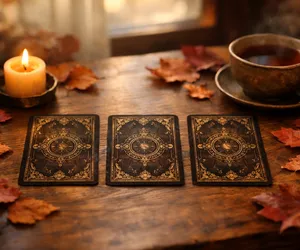
Your 3-Card Tarot Reading: What Fall Holds for Love
Pull a 3-card tarot reading to see what the new season holds for your heart this fall. Simple steps, real card meanings, and free will first.
Last updated by Ava Of Light
What do the cards tell you today?
Ask a clear, concrete question. Then turn the cards to discover their straight answer.
The Lenormand is never read one card at a time: the layout is what makes the answer. Three cards are enough to place a situation in time; it takes all thirty-six for a full picture.
Here are the five spreads most readers use, how to lay each one out, and the three reading rules that belong to this deck alone.
Which spread should you choose?
The five Lenormand spreads at a glance: from the quickest to the most complete.
Three cards
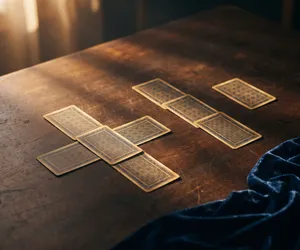
The cross
Nine cards
Grand Tableau
Yes/no and card of the day
✦

Ready for a real change in your love life?
Sarika, Psychic Love Expert with 31 years of experience, helps you reunite with loved ones, heal your relationships and find your soulmate.
This is the entry point to the Lenormand, and the spread most readers use. Three cards in a row, left to right, in the order of time.
Its strength is not the number of cards but the reading in a line: you are not reading three messages, you are reading one sentence. The middle card gives the subject; the ones on either side qualify it.
The layout
An example: the 1 — the 24 — the 25 does not read as “news, love, commitment” but as “news of the heart leads to a commitment”. Swap the 25 for the 10 and the same news leads to a break-up: only the third card changed.
✦

Ready for an eye-opening reading?
Kitt, Love & Relationship Expert with 20 years of experience, guides you to win back a lover, find your soulmate and make empowered choices with honest, no-sugarcoating advice.
The cross adds a dimension the line does not have: it puts the situation at the centre and turns what influences it around the outside. You lay it when the question is not “what will happen?” but “why is this stuck?”
The layout
The bottom card is the one you look at last and the one that changes everything: the 21 there announces a wait, the 7 something unsaid, the 36 a price to pay. All three describe the same blockage, and none of them clears the same way.
✦
Need a real pulse check on your love life?
Ava of Light, tarot & love specialist, offers direct yet encouraging guidance — no sugarcoating, no doom pills, just clear and holistic insight you can trust.
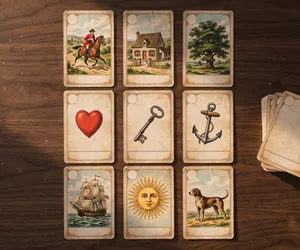
Nine cards laid out three by three. This is the reference spread for a settled situation: wide enough to show the causes, tight enough to stay readable.
Its particularity: it is read three times. In rows, in columns, then in diagonals. The centre card belongs to all three readings — it carries the heart of the question.
The three readings
The same card does not say the same thing depending on which reading crosses it: the 34 in the column of facts speaks of real money; the same card on a diagonal speaks of a financial expectation resting on nothing.
Ask your question to a reader
A nine-card spread takes time and a cool head. If the situation matters and you would rather not read it alone, a professional reader will lay it out with you and put the cards into plain words.
✦
The Grand Tableau is the most complete reading in the Lenormand — and the only one that uses the whole deck. All 36 cards are laid out in a grid, none left in the pile: a whole life is on the table.
Two layouts coexist in the tradition: four rows of eight plus a final row of four, or four rows of nine. The choice does not change how you read: only the shape of the grid differs.
What makes the Grand Tableau is the Houses. Every position in the grid carries a fixed number, from 1 to 36, and the theme of the card that bears that number. The card that falls there changes with every reading. So you always read two things at once: the card, and the House it lands in.
Reading a card in a House
A card that falls in its own House — the House of the Heart occupied by the Heart, say — is traditionally read as a reinforcement: the theme is doubly present.
It is a demanding spread: you need to know all 36 cards before you attempt it. All 36 meanings are set out here.
✦
Two very brief formats, answering different needs.
The yes/no reading needs a closed question — a real one, that can be answered yes or no. You draw an odd number of cards, three most often, and you count: a majority of favourable cards gives the yes, a majority of unfavourable cards gives the no. the 31 and the 16 weigh on the yes side, the 21 and the 7 on the no side. A draw with no clear majority means the question was not closed enough.
The card of the day is drawn in the morning, one card, with no specific question: it colours the day rather than predicting it. It also has a learning virtue — one card a day is the simplest way to get to know all 36.
✦
These rules apply to no other deck, and they matter more than which spread you choose. For choosing a spread to fit a question, see our guide to spreads by question instead.
Rule 1
Reading in pairs
No Lenormand card has a meaning on its own. You always read two cards together, the second qualifying the first. This is the rule that sets this deck apart from the tarot, where each arcanum already carries a complete statement.
Rule 2
Direction and distance
Some cards face a direction: what lies in front of them is what they are moving towards, what lies behind is what they are leaving. And the further a card sits from the significator, the more distant or unlikely what it announces.
These three rules are why the same card never says the same thing twice. They are also what makes the Lenormand more concrete than the Tarot de Marseille: it answers what was asked, precisely, without symbolic commentary.
✦ ✦
The three-card spread. It teaches the essential thing: reading the cards together rather than one by one. Once that reading is second nature, the five-card cross is the logical next step; the Grand Tableau comes much later.
Once. Drawing again because you did not like the answer is changing the question without saying so: the readings contradict each other and nothing is legible any more. If the answer stays obscure, rephrase the question and lay a wider spread.
✦
All 36 cards
The Lenormand deck and the meaning of its 36 cards
By question
Which tarot spread for your question?
Ask now
Put your question to a professional reader
3 ways to talk
How would you like to take the message further?
Our psychics are mediators, trained to receive what you're going through and reflect it back in clear language.
Choose the consultation mode that suits your availability... and your courage of the moment.
At your own pace
Describe your sign and your situation. Our psychic will write you a detailed reading within 24 hours. Take your time reading it, rereading it, coming back to it. No pressure.
Real time without the voice
Chat live with a psychic, without the phone barrier. You read, you write, you formulate. The ideal halfway between written and the intimacy of voice.
The most complete experience
The voice captures what no text can translate: hesitation, emotion, the energy running through you. For the more adventurous, this is the consultation that takes you furthest.
All our consultations are offered in partnership with Wengo, the leading platform for psychic and wellbeing services since 2003.

Article presented by
Ava Of Light
"As a spiritual guide, I specialize in one thing: the magic of love. I combine intuitive Tarot readings with practical spellwork to help you transform your love life. We'll use the Tarot to diagnose the spiritual opportunities and blockages, and then use focused spells to manifest your desires. My go..."
Read on
Pull a 3-card tarot reading to see what the new season holds for your heart this fall. Simple steps, real card meanings, and free will first.
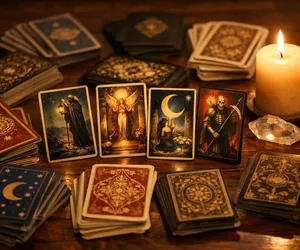
Marseille, Rider-Waite, Thoth, Belline: which is the most powerful tarot? A reader compares their strengths and tells you which deck to choose.
🃏 Your free daily Tarot card draw is here! 👋 Choose 3 powerful cards to quickly reveal the major trends of your day. Love, work, and even your state of mind, you'll know it all instantly. Focus your mind and flip 3 cards to discover what the day has in store for you.

Feeling at a crossroads or simply curious about what the future holds? Looking for clear, direct answers to your questions? You’re in the right place. Welcome to the fascinating world of the free Yes/No pendulum—a simple yet powerful tool that offers immediate, intuitive guidance. Whether you're facing a tough decision or just seeking a little clarity, the pendulum can help you tap into your energy and uncover the answers you need. Perfect for both beginners and seasoned seekers, this experience is not only easy to use but often surprisingly insightful. Ask your question, focus your intention, and let the pendulum reveal what your intuition already knows.
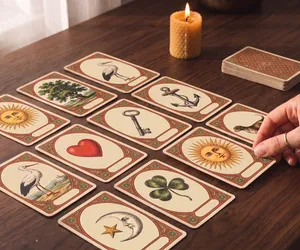
Ternary, cross, evolution, line, monthly: the 5 ways to question the Belline Oracle, with the card layout and the role of each position.
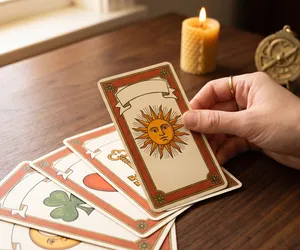
53 cards, 7 planetary families and 4 master cards: discover how the Belline Oracle works, what each family reveals and how to read your spread.
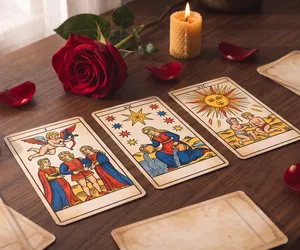
Love touches every part of our lives, bringing both joy and complexity to our hearts. Your questions and stories about romance have inspired us to create this special sanctuary for matters of the heart. Here you'll find love tarot readings, compatibility analysis, relationship guidance, and all the spiritual insights you need to navigate your romantic path. Welcome to your love oracle! 💖
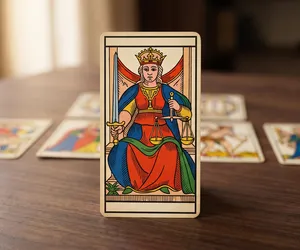
Eighth card of the Tarot of Marseille, Justice embodies truth, karma and accountability. Discover its meaning in love, career and personal growth.
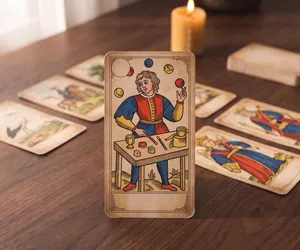
First numbered card of the Major Arcana, The Magician symbolizes manifestation, willpower and skill. Discover its meaning in love, career and finances.
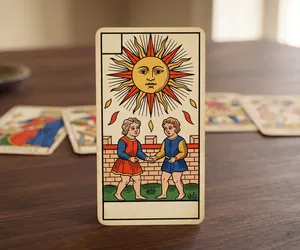
Nineteenth card of the Major Arcana, The Sun radiates joy, success and vitality. Discover its meaning in love, career and personal growth readings.
The Tarot of Marseille is the reference divination tool, used for centuries by professionals for its precision. Enjoy your personalized reading right now.
Choosing a deck, wording your question, shuffling, cutting, reading: the 6 steps to your first tarot reading, plus the 22-day exercise.
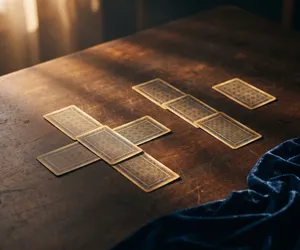
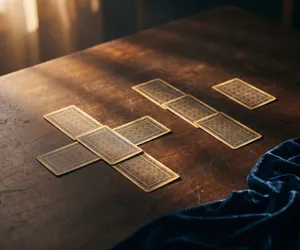
The cross tarot spread explained: the 4 steps, how to calculate the Synthetic Arcana, the 5 positions and a worked example.
The Yes/No tarot reading with the 22 major arcana: the helper, the opponent and the outcome, position by position.


Did you like this article?
Want to know more 🤔 ?
Write directly to the authorAvaOf Light !
Ask Ava a question
Want to share your thoughts? Leave a comment