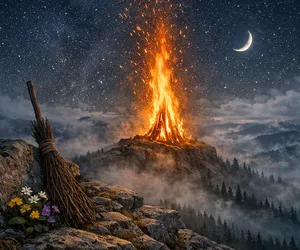
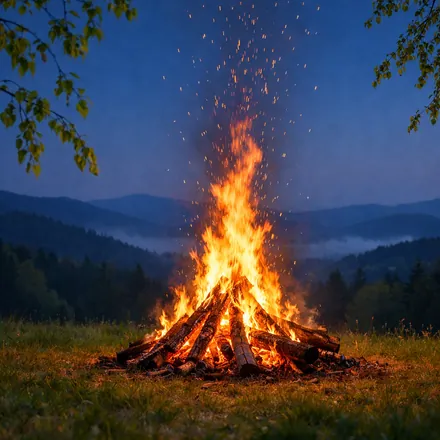
On the night of April 30 to May 1, bonfires blaze from Germany's Harz mountains to the Baltic: this is Walpurgis Night, when winter finally retreats and, legend has it, witches hold their sabbath. Exactly six months from Samhain, it opens the bright half of the year.
An English saint, fires older than she is, a haunted mountain: where does this festival come from, how does Europe still celebrate it, and how can you mark it at home?
✦
Walpurgis Night: where does it come from?
The festival is named after a real woman. Walpurga was born around 710 in Wessex, England. A Benedictine nun, she joined her brothers Willibald and Wunibald, missionaries in Germany, and became abbess of the monastery of Heidenheim, in Bavaria, where she died on February 25, in 777 or 779.
Why May 1? Around 870, her relics were moved to Eichstätt, and tradition holds that she was canonized on a May 1. Her feast settled on that date, and its eve took her name: Walpurgisnacht, Walpurga's Night.
A saint
Walpurga was invoked against storms, and people prayed to her to protect their homes on that night.
A spring fire
Long before her, May 1 was a fire festival: Gaelic Beltane, when herds were driven between two bonfires.
A victory
A powerful symbol: the victory of light over darkness, of good over evil.
The saint lent her name to a night already full of meaning: back in 1749, Carl Linnaeus described Sweden's April 30 bonfires as an "ancient tradition." It sits between Ostara and the summer solstice.
✦















Did you like this article?
Want to know more 🤔 ?
Write directly to the authorMadisonCarter !
Ask Madison a question