The 4 Symbols That Give Christmas Its Sacred Meaning ✨
Beneath the twinkling lights, Christmas carries four very old symbols. Each one becomes a moment of the ritual: here is what they say, and what they can awaken in you.
1. Light in the Heart of the Night 🕯️
Rekindling hope · the morning of the 25th · one flame
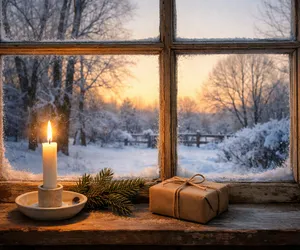
Christmas falls when the nights are at their longest. The liturgy of the day reads this verse from John: “the light shines in the darkness.” The symbol is universal: a single small flame is enough to change an entire room. In this ritual, the light is not there to make a wish or to honor someone who is gone: it greets whatever in you is asking to be rekindled. A white or golden candle works beautifully; if you like to choose, look up what each candle color means first.
Sources: Gospel of John 1:5, read at the Mass of Christmas Day (USCCB lectionary); Wikipedia, “Last Gospel.”
2. Birth: What Starts Small 🌱
Welcoming the new · all day long · without forcing anything
At the center of the Christian story is a child born in a stable because there was no room anywhere else. The symbol says that a beginning often arrives without fanfare, in fragility. To bring that birth close to ordinary people, Francis of Assisi staged a living Nativity scene at Greccio, Italy, in 1223, with a manger, an ox and a donkey: the custom of the Nativity scene grew from there. For you, the birth of Christmas might be a project, a tenderness you thought you had lost, a part of yourself the year left sleeping. On the 25th, you don't ask it to grow: only to be recognized.
Sources: Vatican News, “Betlemme è qui” (2022); Visit Lazio, “Il presepe vivente a Greccio dal 1223”; Thomas of Celano, Life of Saint Francis, cited by both.
3. The Gift That Expects Nothing 🎁
Opening the heart · during the day on the 25th · a quiet gesture
Before it became a pile of packages, the Christmas gift recalled a gift received without being earned. Saint Nicholas, a fourth-century bishop of Myra in what is now Turkey, and the distant ancestor of Santa Claus by way of the Dutch Sinterklaas, is remembered for giving in secret: legend says he dropped gold through the window of three poor young women at night and asked that no one be told. The gesture in this ritual is of that kind: giving something without expecting anything back, not even a thank-you. A donation, a meal, an hour of your time, a note for someone who isn't expecting one.
Sources: Wikipedia, “Saint Nicholas” (the three daughters' dowry, secret gifts, Sinterklaas); Franciscan Media, “Saint Nicholas: The Original Santa Claus.”
4. Welcome: A Place at the Table 🍞
Connecting · at Christmas dinner · one extra plate
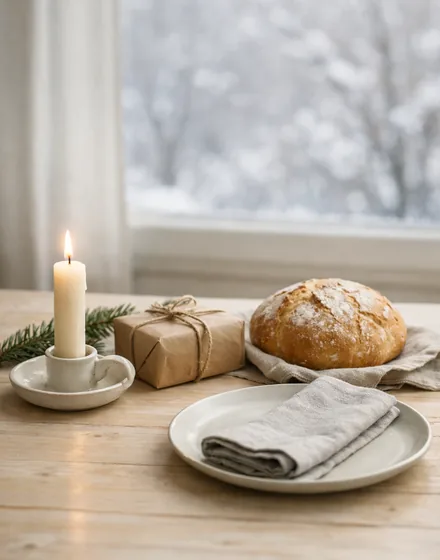
The Nativity story begins with a refusal: there was no room for them at the inn. Many traditions answered with an open table. In Provence and across rural France, families set an extra place, “the place of the poor,” for the traveler or stranger who might knock at the door, a custom that lasted until the mid-twentieth century. The last moment of the ritual revives it: one extra plate, or an invitation to someone who would otherwise spend Christmas alone.
Sources: Aleteia, “La place du pauvre, une tradition de Noël à faire revivre” (2019); Guichet du Savoir (Lyon municipal library), citing Martyne Perrot, Ethnologie de Noël; French Wikipedia, “Gros souper.”
✦














Did you like this article?
Want to know more 🤔 ?
Write directly to the authorMadisonCarter !
Ask Madison a question