

Which Zodiac Signs Are the Luckiest? 🍀
Pisces, Sagittarius, Taurus: according to tradition, Jupiter and Venus, the planets of luck, are at home there. The ranking of all 12 signs.
Last updated by Ava Of Light
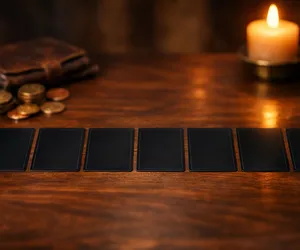
You open your banking app on a Sunday evening, close it, then open it again twenty minutes later as if the number might have moved. Money tarot will not fill your account: it names the energy circling your budget, the one that has been making decisions on your behalf for years. Below, six cards are waiting, numbered 1 to 6. Take your number now, before you scroll past the table.
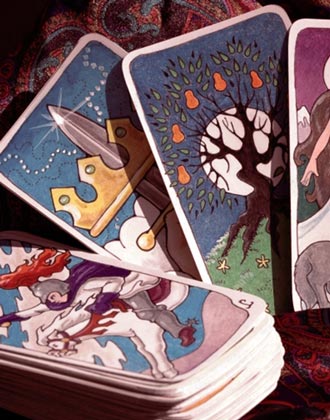
Today’s Love Tarot — Instant Answers
Think of your person or your burning question, take a deep breath, and reveal today’s Tarot message
You don't need to be psychic, and you don't need a deck on the table. With finances, the quality of a reading depends almost entirely on the question you ask. Three ground rules, then go pick.
Ask a question you have a part in. "Am I going to earn more?" turns you into a spectator of your own budget. "What decides for me when I spend?" puts you back in it, and it's the only version you'll do anything with on Monday morning.
Have a real number in mind. Whatever you spent last month outside rent and groceries: rough is fine, embarrassing is fine. A card laid over a blur gives you a blur back; laid over a shaky number, it gets surprisingly sharp.
Take the number that comes first. Between 1 and 6, no deliberating. If two numbers fight over it, keep both somewhere in the back of your mind: we'll get to what that hesitation says.
For anything bigger than a single card, our guide to the tarot spread for your question sets out which method suits which kind of question; a money question is nothing like a love question.

Here are the six energies at a glance; the detail follows below. Pick your number before you read the table: once you've seen all six rows, your reasoning takes over, and it always heads for the most flattering box.
| Your card | The energy around your budget | The card that shifts it |
| 1 · The Magician (I) | You start everything, you keep nothing | The Emperor: hold what exists |
| 2 · The Wheel of Fortune (X) | Your income rises and drops again | Temperance: live on the average |
| 3 · The Devil (XV) | You spend to take the edge off | The Star: come out of the numbness |
| 4 · The Empress (III) | You pay for everyone | Justice: one line, one ceiling |
| 5 · Temperance (XIV) | You tighten until there's nothing left to live on | The Sun: reopen one pleasure |
| 6 · The Hierophant (V) | You manage money the way you were taught | The Fool: write your own rule |
Decipher the wisdom of the cards 🔮
👉 Explore your tarot journey →
🔮 Let the ancient wisdom of tarot guide your path
The Magician stands at a small crowded table: a cup, some coins, a knife, and the wand, already in his hand. Everything is out, nothing is put away. Card I of the Major Arcana is the card of beginnings: he opens, he tries, he starts over, and he never closes a drawer.
This card is yours if:
Your energy is a genuine asset: you know how to bring money in, and plenty of people can't. What's missing is the move that keeps it, and that move is never exciting. Nobody brags at dinner about the forty dollars they moved into savings. The Magician tarot card shows potential still fully intact, laid out on the table, waiting for someone to choose one of the tools.
The move: open a second account this week and set up an automatic transfer for payday. Five percent is enough. Above all, don't wait until you "have some room": that room never arrives, which is precisely what the card is telling you.
The ally card: The Emperor (IV). Seated, scepter on his knee, eagle on the shield. He holds territory that has already been won and spends his time keeping it. That's exactly the muscle you're missing.
Three animals on a wheel: one climbing, one settled at the top, one tipping off. And on the side, a crank. That's the detail everyone forgets in card X: the wheel doesn't turn by itself, somebody works it.
This card is yours if:
Irregularity on its own is very manageable. It's the missing average that hurts. As long as each month is judged on its own, a good month looks like wealth and a bad one like disaster, whereas both are just two points on the same curve. Our financial tarot for autumn lands on the same thing every season: the budgets that break are rarely the smallest ones, they're the most irregular.
The move: add up your last twelve months, divide by twelve, and live on that figure, not on September's. Anything above it goes to the second account and stays there. You've just taken hold of the crank.
The ally card: Temperance (XIV). The angel moves liquid from one vessel to the other at a constant rate. The gesture completely ignores how full each vessel is, which is handy when your months look nothing alike.
The Devil stands on a pedestal, torch in hand. At his feet, two small figures wear collars roped to that same pedestal, hands tied behind their backs. The detail matters: the Devil isn't holding the rope, the base is. Card XV is about attachment to a structure, never about punishment.
This card is yours if:
Guilt-talk gets you nowhere here. Spending works: it acts fast, it acts reliably, and it costs less than a whole evening spent brooding. The trouble starts when it's become the only tool in the box. The base that rope is tied to is rarely in your wallet, by the way: the same card XV turns up in career tarot, around jobs people keep for what they'd lose by leaving.
The move: for seven days, before every non-essential payment, write down one single word: the feeling, not the object. Tired, angry, empty, proud, bored. Read the column back on Sunday night: you're not holding a list of purchases, you're holding a list of things you couldn't handle another way. Most people I've suggested this to stopped on their own after four or five days, purely because writing the word was enough.
The ally card: The Star (XVII). Kneeling at the water's edge, a naked young woman empties her two jugs, one into the river, one onto the earth. She has nothing to protect and nothing to make up for: the calmest card in the deck.
The Empress is seated, scepter on one side, shield on the other, and she takes up the whole card without effort. Card III of the Major Arcana is a card of abundance: the kind that overflows and feeds everything around it, sometimes without checking what's left in the middle.
This card is yours if:
There's nothing to fix about generosity. The problem is when it becomes automatic: once giving is part of who you are, refusing even once feels like betraying somebody. And an expense you won't let yourself look at always shows up somewhere else, in the overdraft or in your sleep. Astrology describes the same mechanism through the second house and Venus: see money in your birth chart.
The move: give that generosity a line and a monthly ceiling, decided by you at the start of the month. What fits in the line goes out guilt-free. What goes over waits for next month. And say no once this month, on a small amount, just to see that nobody collapses.
The ally card: Justice (VIII). Seated facing you, scales in one hand, sword in the other. She measures first and cuts second, in that order. Weigh it. That's all Justice asks.
An angel pours the contents of one vessel into the other without spilling a drop. We remember the control in the gesture; we forget that the gesture is above all about keeping things moving. A vessel you keep full serves no purpose at all. And yes, this is the same card that rescues card 2: overdone, balance quietly turns into a brake.
This card is yours if:
Excessive control is a money wound just as much as compulsive spending: in both cases a number is deciding for you. This one is stubborn, because it gets socially applauded: nobody will ever warn you that you're saving too much. Read what the Temperance tarot card actually says: it's a card about flow rate, about how fast things move through your hands.
The move: create a small, non-negotiable "pleasure" line that absolutely has to be spent before the month ends. Book the appointment you keep postponing, today. Savings that never fund anything end up looking like a waiting room.
The ally card: The Sun (XIX). Two children standing under a sun with a human face, very close to one another. It's the only card in the deck where somebody is visibly allowed to be happy right now.
The Hierophant, "Le Pape" in the Marseille deck, raises his hand in front of two kneeling figures. Card V is the handed-down rule: you receive it before you're old enough to argue with it, and you apply it long after forgetting who came up with it.
This card is yours if:
My grandmother kept cash in envelopes, one per category, and you never raided the envelope next to it. I kept that habit for about fifteen years without once asking whether it suited my life. It worked for her, on a fixed salary with steady expenses. It didn't work for me at all: my income changed every quarter, and the emergency envelope was empty by February. The rule was a good one. It just wasn't meant for anyone but her.
The move: write down the three lines about money you heard most as a child. Put a check mark next to each one that still matches your actual situation today. Whatever has no check mark, you're allowed to let go of: it wasn't your decision in the first place.
The ally card: The Fool. The only card with no number. Bundle over his shoulder, he moves without anyone having approved the route.
Because a card doesn't ask for a single figure. That's its big advantage over a spreadsheet: you can look at it without feeling judged, so you look at it for longer.
Money is still the thing we're worst at talking about. People tell me about their divorce well before they tell me what they earn, and I understand why: an amount invites comparison, an image doesn't. Putting a card on the table shifts the conversation from "how much" to "how", and "how" is the only part you actually have a hand in.
The twenty-two major arcana suit this exercise particularly well because they describe movements. Nothing in the deck corresponds to a sum. There are, however, images for what circulates, what stagnates, what scatters and what accumulates: far more useful for understanding a budget than the balance on the last day of the month.
It happens often, and it's actually a good sign: money energies almost always combine. The Magician and the Wheel are the classic combination: money comes in fine, and leaves just as fast. The Devil and the Empress meet over spending that exists to soothe somebody, yourself or others. Temperance and the Hierophant pair up in people who apply a rule they never wrote, and apply it far too conscientiously.
To settle it, don't reread the descriptions: reread the "this card is yours if" lists. The one that made you raise an eyebrow is pointing at your card, even if the other story appeals to you more. "That's not quite me, but almost" is generally the phrase people use when it is exactly them.
Then pick just one move, the one that fits in an evening. The other five cards aren't going anywhere: you can come back next quarter, with different figures and a calmer eye. The mechanism works anywhere we tell ourselves stories, incidentally: free love tarot runs on exactly the same recognition, with different cards and different blind spots.
No. No reading knows your industry, your employer or when your clients pay. What it does light up is your part in it: the decisions you keep postponing, the spending you've stopped counting, how you habitually react to a surprise. Nobody makes a movie out of that, but you can act on it Monday.
None of them, and that's the whole point. There is no winning number here: each of the six names a habit, and each comes paired with an ally card that says what to do about it. The useful half is always that second card, because it's the only part of the pair you can act on this week.
Yes, to shed light on your motivation, never to sign on your behalf. A reading is fairly good at telling you whether you're buying out of need, out of weariness, or to please someone. It says nothing about the interest rate, the warranty or what you can afford to repay: for that you need a spreadsheet and sometimes an advisor.
Actually, that's often the best time to read, with one caveat: don't ask "am I going to be okay?". That question invites a reassuring answer you'll do nothing with. "What do I stop this month?" gives a less pleasant reading and a far more useful one.
That's one of the best uses for it. Each of you picks a number separately, then you compare: the discussion starts from two images instead of two accusations. You'll often find you didn't get the same card at all, and that this is precisely where the Saturday morning arguments come from.
The six cards describe habits. That's all they describe. None of them says you're bad with money: at most they point to the part of your budget you stopped looking at. The arcana sketch tendencies, and a tendency can be corrected: the hand on your accounts is yours, not the card's.
Money tarot is only worth anything if it leads to something concrete and tiny before the week is out. If your number said nothing to you at all, note that too: go back through the Tarot of Marseille cards one card at a time, and let a different image do the work instead.
Editor's note: the smallest stepSix lists would be six projects, and you'd start none of them. Keep only your card and its move, the one that fits in an evening: an automatic five percent transfer, a ceiling on what you give, an appointment finally booked. At the very least you'll have stopped looking away. And if your card woke up an older money story: a loan that drags on, a family debt never settled, an expense you can't explain to yourself, half an hour with a tarot reader often clears the ground faster than a month of spreadsheets. |
You definitely know someone whose budget has become a running joke among their friends: a joke they usually tell themselves. Send them this and just ask them for their number: the conversation that follows is generally worth it. 💬
Read more:

Article presented by
Ava Of Light
"As a spiritual guide, I specialize in one thing: the magic of love. I combine intuitive Tarot readings with practical spellwork to help you transform your love life. We'll use the Tarot to diagnose the spiritual opportunities and blockages, and then use focused spells to manifest your desires. My go..."
Read on
Begin Your 2026 with Confidence


Pisces, Sagittarius, Taurus: according to tradition, Jupiter and Venus, the planets of luck, are at home there. The ranking of all 12 signs.

A relationship going in circles, a loyalty that wears you out, a past that sticks to your shoes? In 2027, you finally cut it. I'll tell you which one, and when.

Your way of loving changes in 2027, and you're going to adore the new version. Sign by sign, I'll tell you what shifts in your heart and when it happens.

In 2027, you don't slam the door: you close it, properly. I'll tell you which chapter your sign will end, in which season, and what opens up behind it.

Sun enters Scorpio at 05:37 "Dive fearlessly into your inner depths: what you feel with honesty becomes the source of your spiritual power."

Mercury in Scorpio turns retrograde Turn inward with courage: beneath the surface of every feeling, your soul is whispering the truth that sets you free.


Did you like this article?
Want to know more 🤔 ?
Write directly to the authorAvaOf Light !
Ask Ava a question