Precious and semi-precious stones have amazing powers. From ancient times to the present day, moonstone has been associated with the feminine and with the night star, for its gentleness and milky glow.
Origins, legends and benefits: set off to discover this mineral, we tell you everything.
Color
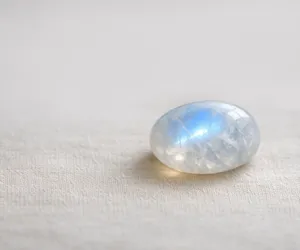
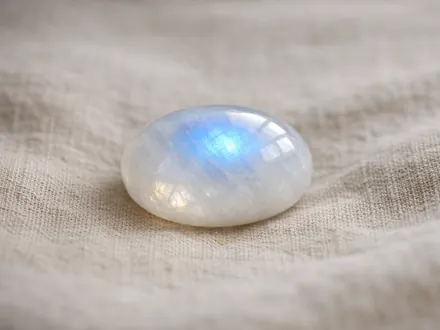
Colorless, white or with bluish and silver shades
Composition
Feldspar (orthoclase or adularia)
Price
From $19 for a piece of jewelry
✦
Origins: from fish eye to moonstone
Once known as “fish eye,” moonstone now bears a more poetic name that comes straight from the sky: it gives off the same glow as the star whose beauty it recalls. The floating, bluish sheen that glides across its surface when you turn it has a name: adularescence, caused by light scattering between the thin layers of the mineral.
It is a feldspar: in 1801, the mineralogist René Just Haüy named “orthoclase” the mineral of which it is a variety. It has also been called hecatolite, after Hecate, Greek goddess of the moon, and adularia, after Mount Adula in the St. Gotthard massif. The finest come from southwestern Sri Lanka, but they are also found in India, the United States, Madagascar, Burma, Australia, Brazil and Tanzania.
✦











Did you like this article?
Want to know more 🤔 ?
Write directly to the authorMadisonCarter !
Ask Madison a question